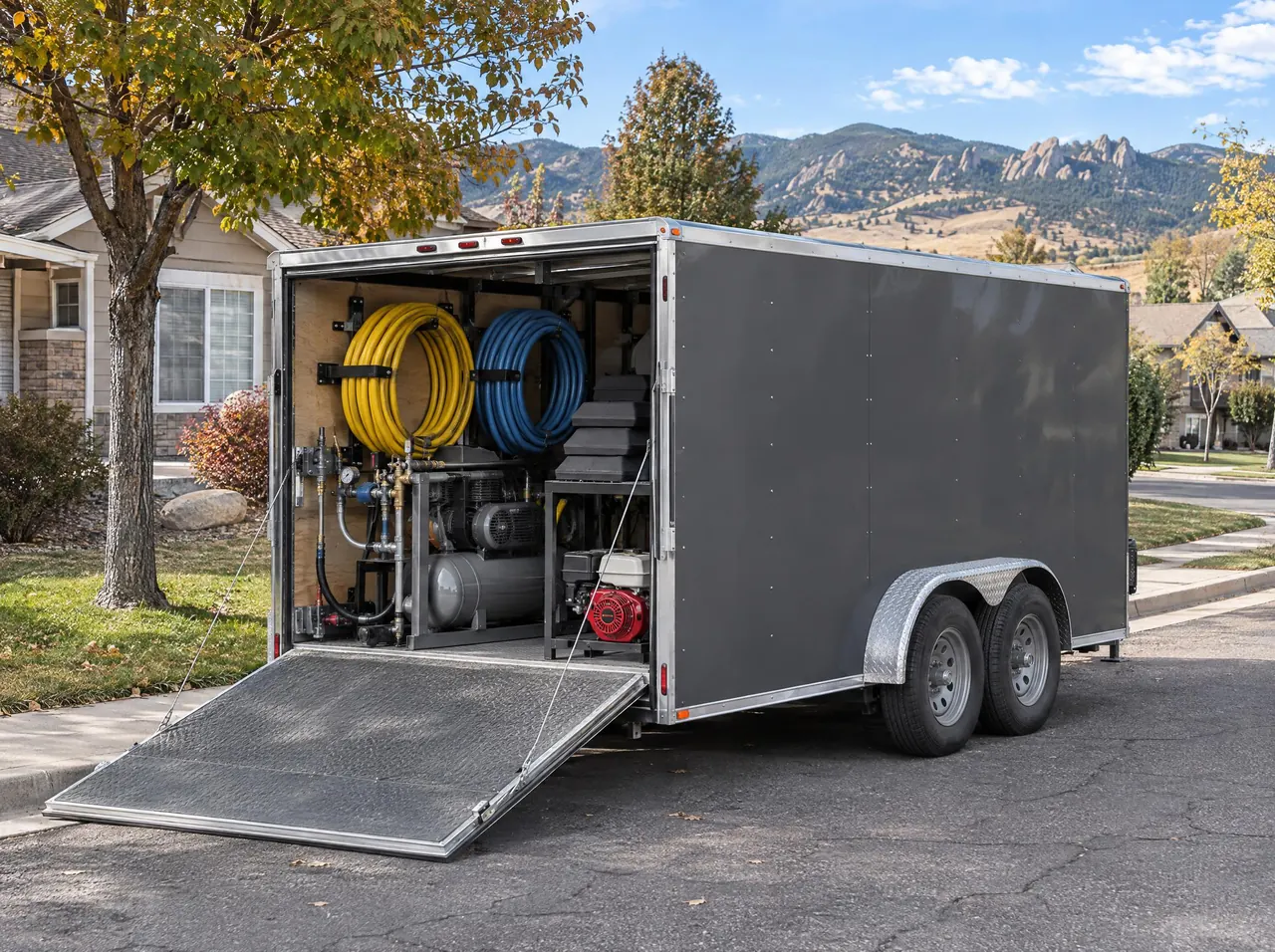
Unbranded concrete leveling equipment trailer parked at a residential curb
Our process

The concrete leveling process

What happens between the first measurement and a slab you can walk across without thinking about it, and how we decide between polyurethane foam and mudjacking for each job.

Illustration
Before anything is drilled

A lift is only as good as the diagnosis.

Our concrete leveling process starts with the reason the slab moved. Raising a panel without dealing with the water or the void that dropped it is how slabs end up sinking twice.

On the first visit we measure the offset at every joint that matters, tap or sound the slab to find hollow areas, and walk the perimeter. Downspouts that empty against the slab, a lawn graded toward the house, sprinkler heads aimed at concrete, and gaps where a patio meets the foundation all leave clues. Along the Front Range we also keep expansive clay in mind, because soil that swells and shrinks with moisture can move a slab in either direction.

Then we decide whether leveling is the right repair. It usually is when the slab is in one or a few large pieces and the cause can be controlled. It isn't when the concrete is shattered, when a tree root has pushed the slab up, or when the movement is part of a foundation problem that belongs with a structural engineer.

How leveling works

Engineering the correction.

A settled slab rarely broke. The ground under it moved. Leveling fills the space that opened up under the concrete and raises the slab back to grade, through holes small enough to patch.

Two-part foam expands under the slab, fills the void and lifts. Light, so it adds very little load to soft soil.

  1. Measure and find the cause

    Record the offset at each joint and look for the water source, void or fill problem behind it.

  2. Drill access holes

    A planned pattern of small holes through the slab, sized for the material.

  3. Fill the voids

    Material goes in under pressure and fills empty space first.

  4. Lift to grade

    Injection continues in short stages while the slab is watched against a level line.

  5. Patch and seal

    Holes are patched, then joints and cracks are sealed to keep water out.

Cross-section of a settled concrete slab being leveled Two slabs on soil. The right slab has dropped about one inch into a void. Holes are drilled, material is injected underneath, and the slab rises until it is flush with the left slab. SUBGRADE TARGET GRADE JOINT OFFSET AT JOINT 1.00 IN POLYURETHANE FOAM ยท ~5/8 IN PORTS
Diagram, not to scale. The drop is exaggerated so the movement is visible.

On site, in order

A typical residential job follows the same sequence whether the slab is a driveway, a patio or a run of sidewalk. Commercial work adds traffic control and scheduling around the people who use the space, but the steps are the same.

  1. Set a reference. A string line, straightedge or laser gives a fixed target so the lift is measured, not judged by eye.
  2. Drill the pattern. Holes go through the slab in a layout planned for the void and the slab's size. Foam ports are about 5/8 in; slurry holes are larger, roughly 1 to 2 in.
  3. Fill before lifting. The first material fills empty space under the slab. Until the void is full, the slab doesn't move.
  4. Lift in short stages. Injection continues at several holes in turn so the slab rises evenly. The crew stops and checks often.
  5. Patch the holes. Holes are filled with a cement-based patch and finished flush.
  6. Seal the joints. Open joints and cracks get a flexible sealant so surface water has a harder time reaching the subgrade.
Field note

Slabs that connect, such as a stoop and the walk below it or a garage apron and the first driveway panel, are lifted as a group. Raising one alone can pinch or crack the joint between them.

How we choose between foam and slurry

Both methods fill the void and raise the slab. They differ in weight, hole size, cure time and cost of material, and those differences decide the job. The detailed pages on polyurethane foam leveling and mudjacking in Denver cover each one in depth.

What matters on the jobPolyurethane foamMudjacking slurry
Hole sizeAbout 5/8 inRoughly 1 to 2 in
Weight added to the soilVery lightHeavy, cement-based
Ready for useFoot traffic usually the same dayNeeds more curing time before vehicles
Behavior in wet groundDoesn't wash outCan be affected if water keeps flowing under the slab
Material costHigherUsually lower

Soft or wet soil tends to favor foam because it adds very little load. A large, dry void under a slab with no rush to drive on it can be a reasonable slurry job. We explain the reason for our recommendation in plain terms, so you're not choosing a method blind.

After the lift

Most repeat settlement comes from the same water that caused the first one. The best thing an owner can do after any concrete leveling job is move water away from the slab.

  • Extend downspouts so they discharge several feet past the edge of the concrete.
  • Adjust sprinkler heads that spray onto slabs or soak the soil along their edges.
  • Keep joints sealed. Check them each spring after the freeze-thaw season.
  • Watch the grade along the foundation and fill low spots so water runs away from the house.
Bottom line

Measure first, fix the water, lift slowly, seal the joints. Every job we do follows that order, whichever material goes under the slab.
How long does a concrete leveling job take?

Most residential jobs, such as a driveway section or a run of sidewalk, take part of a day on site. Larger commercial areas or several slabs that tie together take longer. We give you a time estimate once we have measured the slabs.

Do I need to be home while you work?

Not usually for exterior slabs, as long as we can reach the work area, a water spigot if the method needs it, and you've moved vehicles and furniture off the slabs. For garage and basement floors someone needs to let us in.

Will the holes show afterward?

The holes are patched with a cement-based patch. Patches are visible up close because new patch material rarely matches weathered concrete exactly, but they are small, especially with foam ports at about 5/8 in.

When can I drive or walk on the slab?

Foam-lifted slabs can usually take foot traffic the same day. Slurry needs longer to cure before vehicle traffic. We tell you the exact wait for your job before we leave.

Request an estimate

Let's get it level.

Tell us which slab has moved and where it is. Photos help. We look at the measurements, ask about drainage, and come back to you about the next step.

  • PhoneBeing set up. Use the form for now.
  • EmailUse the form; replies come from our team.
  • Based inDenver, Colorado
  • CoverageColorado Springs to Fort Collins along I-25. See every area
Up to 5 photos, 10 MB each. A wide shot plus a close-up of the worst joint helps most.

Your details go only to Concrete Leveling Denver. See the privacy policy.

Request an estimate