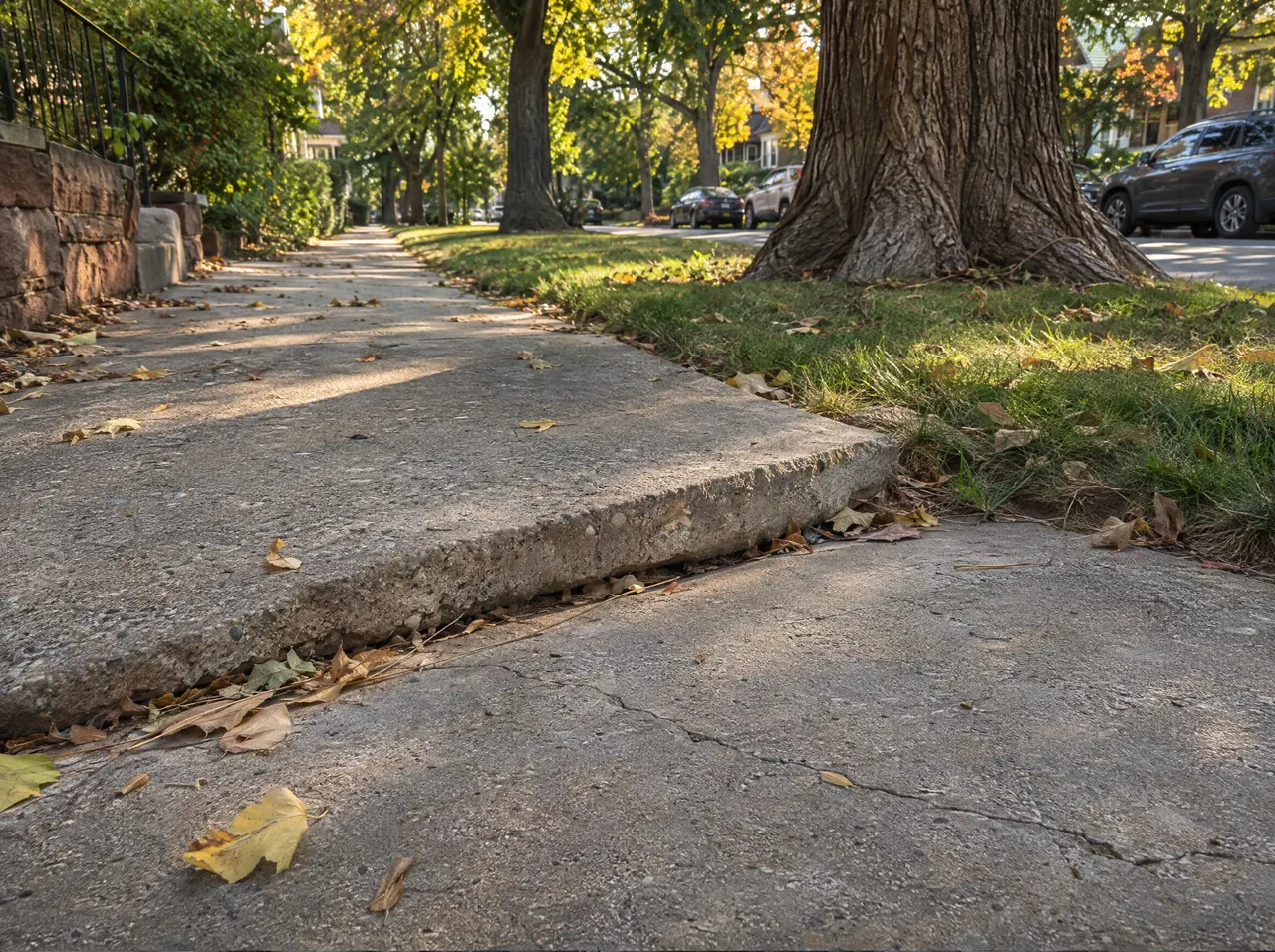
Older blocks near Old Town, newer streets toward I-25
Fort Collins grew outward from Old Town and the Colorado State University campus, so the concrete you're dealing with depends a lot on where you live. Near downtown, the houses are older, the street trees are big and the sidewalks have taken decades of freeze-thaw. Out toward Harmony Road and I-25, most homes went up in the last few decades, often inside HOA neighborhoods, and the concrete is younger but sits on ground that was dug up and refilled during construction.
Those settings fail in different ways. A fix that suits a 1950s front walk can be the wrong call for a driveway poured fifteen years ago.
| Property | What tends to go wrong | What usually fits |
|---|---|---|
| Older homes near Old Town and campus | Front walks and stoops that dropped slowly over many years; panels pushed up by tree roots | Lift the settled panels; root work or replacement where a root did the pushing |
| Rentals and small multifamily | Trip edges along shared walks, sunken entry steps | Sidewalk and step lifting, then joint sealing |
| Subdivisions built since the 1990s | Driveway panels and garage aprons dropping near the house | Driveway leveling, often with foam |
| Any lot with an irrigated lawn beside the slab | One edge of a walk or patio sinking where sprinklers keep the soil wet | Lift the slab, then change the spray pattern |
Big street trees and the heave-or-settle question
Mature trees are a big part of the appeal of the older Fort Collins neighborhoods, and they cause a share of the uneven sidewalk there. A root growing under a panel pushes it up. From the street that looks like any other trip hazard, but leveling can't help, because the problem panel is already too high.
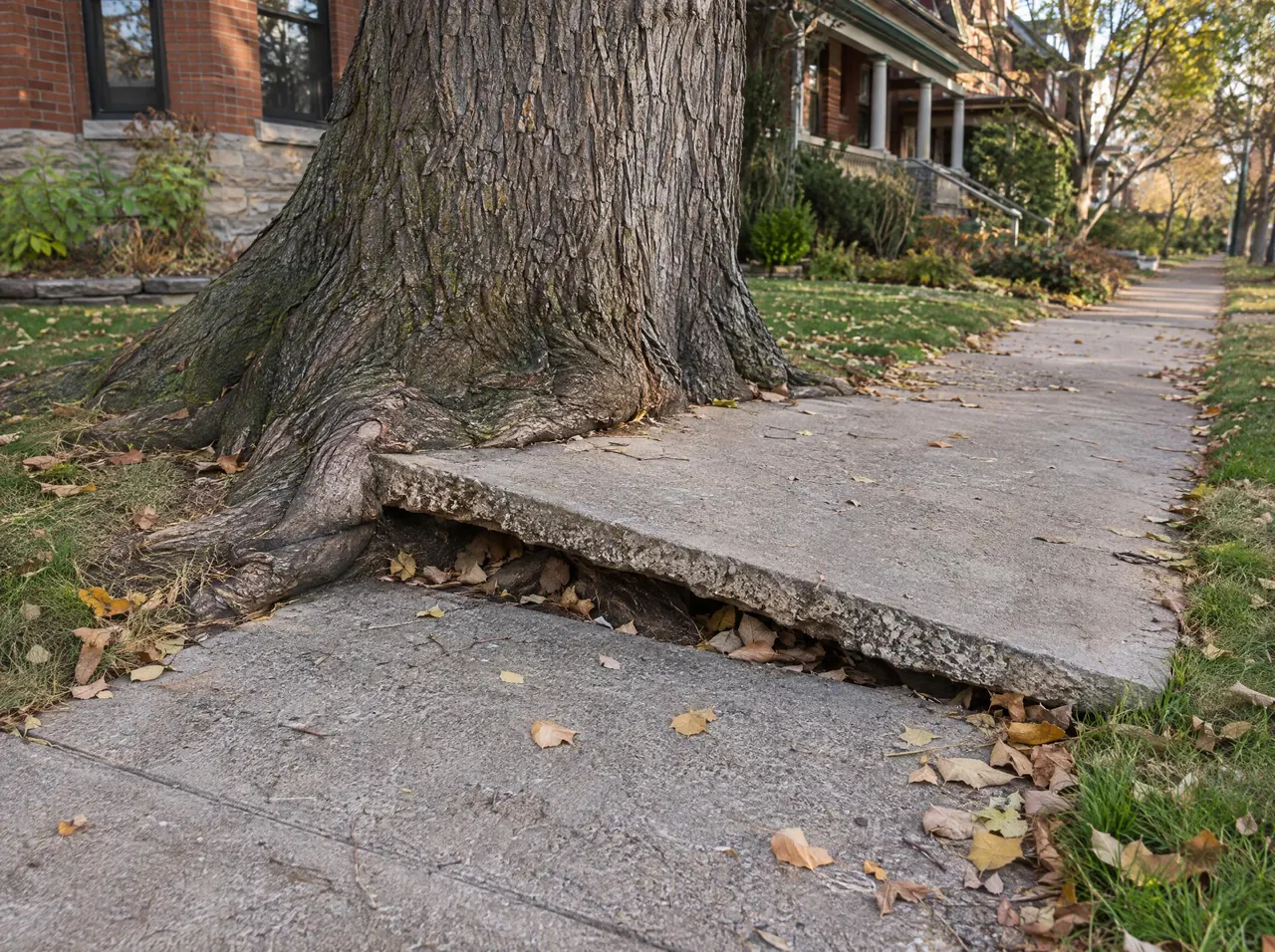
A quick way to tell: stand on the low side and look at the panel next to it. If the high panel tilts up toward a tree, a root is the likely cause. If the low panel has dropped and its neighbors sit flat, it probably settled, and that panel is a candidate for lifting. Many older blocks have both problems within a few feet of each other, so each joint gets judged on its own.
Rental properties near CSU
A lot of the housing around the university is rented, and landlords end up owning trip hazards they never walk on. Tenants turn over every year or two, nobody mentions the walk that crept down half an inch, and the issue only surfaces when someone catches a toe on it.
On a rental, we'd check the route from the street to each entry, any shared side walks and the steps. Foam tends to suit occupied properties: small holes, little mess, and a walk that is back in use quickly. Our page on sidewalk trip hazard repair explains how an offset gets measured and lifted.
Lift first, seal second. Sealant in the joints keeps water from reaching the base through the gaps, but it has to go in after the panels are back in line or it gets torn out. The joint and crack sealing page covers that last step.
Driveways in the newer parts of town
In subdivisions from the last few decades, the classic complaint is a driveway sagging at the garage door. The soil right against a foundation is excavated and backfilled when the house goes up, and backfill that wasn't compacted well keeps settling for years. Downspouts emptying beside the driveway speed that up. In parts of the area, expansive clay soils (documented by the Colorado Geological Survey along much of the Front Range) add movement as they wet and dry.
A driveway panel that dropped as one piece is usually a good lifting candidate. Leveling a sunken driveway goes through what pushes a given slab toward foam or toward mudjacking.
Tell us which slab in Fort Collins moved and roughly how far, and we'll set up a time to measure it.
Request an estimateThe public sidewalk in front of your house
Before anyone works on the walk between your yard and the street, check with the City of Fort Collins. That strip is usually public right-of-way, and Front Range cities handle repairs there in different ways. The city can tell you what applies on your street.
If the job turns up a drainage fix that involves digging, such as burying a downspout extension, call Colorado 811 to have utilities marked first.
Where Fort Collins sits on our route
This is the top of our service area, roughly 65 miles north of Denver on I-25. College Avenue (US-287) runs north-south through the middle of the city, and the Cache la Poudre River crosses the north side of town near Old Town. Neighboring Timnath, just east across I-25, has a very different, much newer housing stock.
In the older neighborhoods, figure out whether a panel sank or got pushed up before you call anyone. In the newer ones, watch the driveway near the garage and the downspouts beside it.