No city hall: who handles what
Highlands Ranch is one of the largest communities in the Denver area, but it isn't a city. It's an unincorporated part of Douglas County along C-470, roughly 15 to 20 miles south of downtown Denver, and it has been developed as a master-planned community since the early 1980s. Jobs a city would normally handle are split among the county, a metro district and community associations.
For concrete leveling in Highlands Ranch, that split matters the moment the slab in question isn't clearly on your own lot. Use this as a starting point, and confirm with the entity named before any work on shared concrete.
| Concrete | Who to ask first |
|---|---|
| Patio, driveway, stoop or walk on your lot | Your decision; check covenants if your association reviews exterior work |
| Public sidewalk along the street | Douglas County or the metro district serving your area |
| Trails, common-area walks, pool and amenity concrete | The association or district that owns them |
| Anything involving digging, such as drain lines or regrading | Colorado 811 for utility locates first |
Concrete ages street by street
Because Highlands Ranch was built in phases over several decades, the age of the concrete changes from one neighborhood to the next. Homes from the early phases now have driveways and walks that have been through forty-odd winters, while the newest streets have slabs whose foundation backfill may still be compacting. Older slabs tend to show open joints and settled walk panels; newer ones tend to show drops at the garage and patio edges.
We level concrete for associations and districts as well as homeowners, but the owner of the slab has to request and approve the work. Larger shared sites follow the approach on our HOA and commercial concrete leveling page.
Graded lots and the back patio
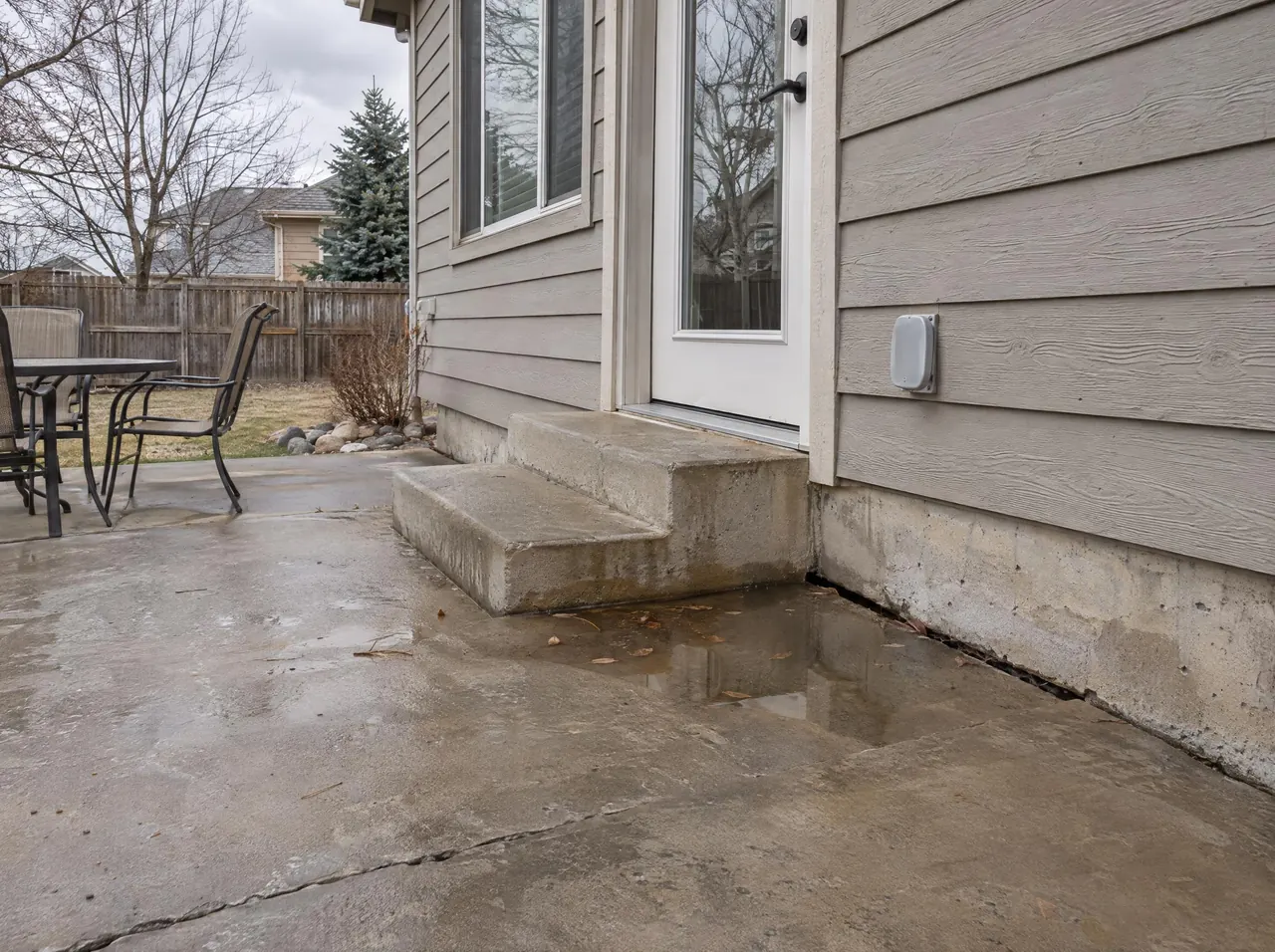
Master-planned neighborhoods are typically graded into house pads with swales between lots to carry runoff toward the street. That works until a downspout, an irrigation zone or a swale that's been filled in by landscaping puts water where it wasn't meant to go. Concrete closest to the house sits on foundation backfill, which settles more than native ground. Put the two together and the back patio becomes a frequent complaint: a slab that has dropped along the wall and now tilts toward the foundation.
The tilt is the part worth fixing first. A patio that drains toward the house delivers roof and sprinkler water to the soil beside the foundation, the last place it should go. Lifting the low edge restores the fall away from the wall. Our page on patio, porch and step leveling covers stoops and steps, which often settle for the same reason.
Lay a level on the patio, note which way it falls, and send a photo so we can look at the slope with you.
Request an estimateRolling ground and clay soils
Much of Highlands Ranch is rolling, not flat, with streets that climb and dip and lots that sit above or below their neighbors. Retaining walls and sloped side yards are common, and runoff from an uphill lot ends up against whatever concrete is downhill of it. Expansive clay soils, which the Colorado Geological Survey has documented along the Front Range, occur in parts of the south metro as well. Clay that swells when wet and shrinks when dry can move a slab both ways over a year.
Lifting suits a slab that sank and stayed there. A slab that keeps moving with the seasons needs its water sorted out before a lift will hold. And a slab that sounds hollow but hasn't dropped can be supported with slab void filling before it cracks.
Confirm who owns the slab before anything else. On your own lot, the back patio and the garage apron are the usual places settlement shows up, and both are good lifting candidates once the water is redirected.