Hillside lots change what leveling means
Castle Pines sits on the west side of I-25 between Lone Tree and Castle Rock, about 25 miles south of downtown Denver. It's one of the newer cities in Douglas County, and its neighborhoods were built into rolling, wooded ground with ponderosa pine and scrub oak. Many homes sit on lots that fall toward or away from the street, some steeply.
On a slope, "level" is the wrong word for the goal. A driveway that climbs from the street to the garage was never flat. What concrete leveling in Castle Pines restores is the original plane: each panel back in line with the panels around it, joints flush, and water running the way the builder intended.
Steps take the most abuse
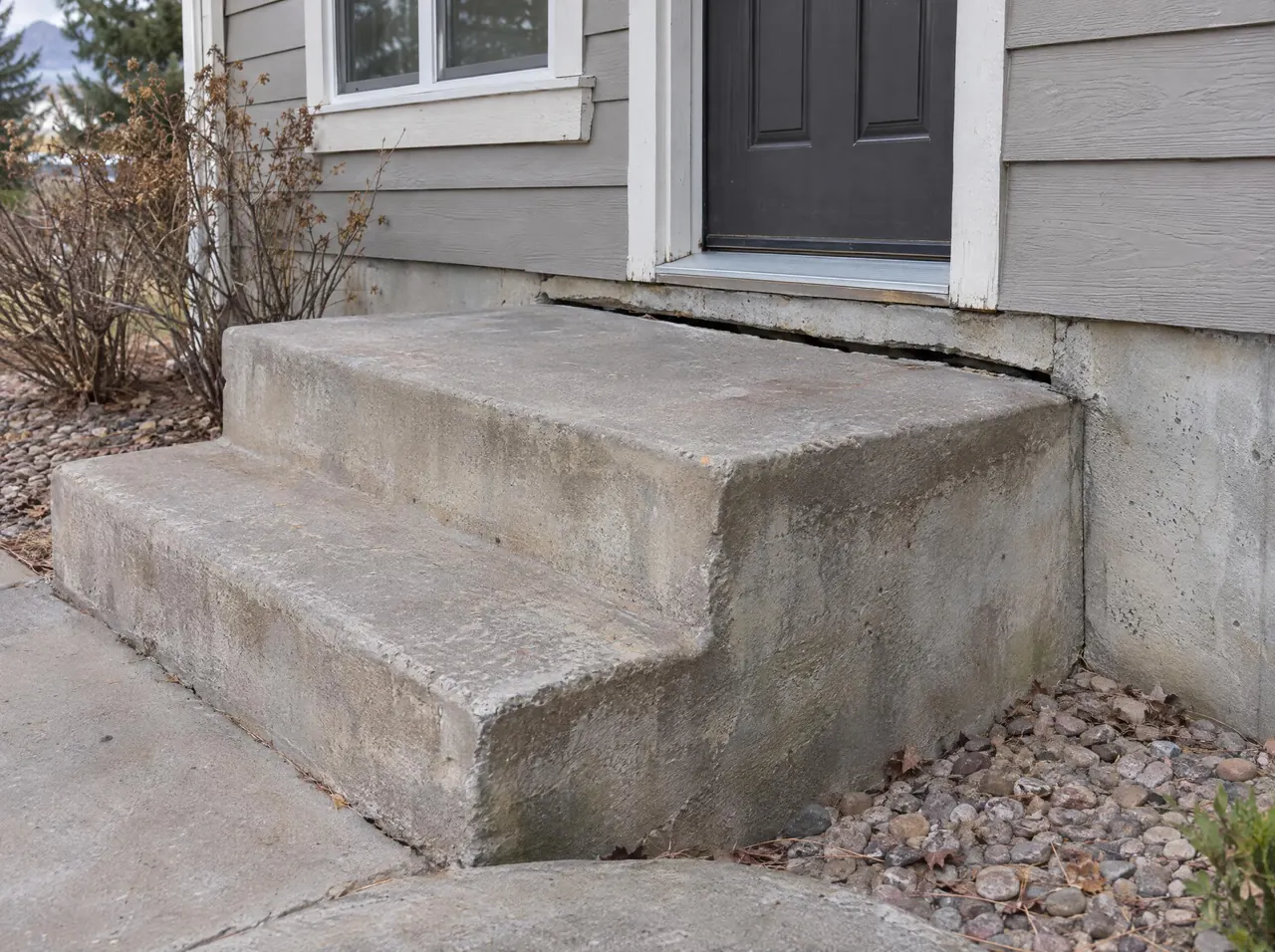
Hillside houses tend to have more steps: from the drive up to the front door, from a walkout basement down to the yard, from a deck to a lower patio. Each set rests on soil placed after the foundation went in, and a concrete step unit concentrates a lot of weight on a small footprint. When that fill compacts, the steps tip away from the house or drop at the outer edge. You see a gap opening at the foundation and risers that no longer match.
Walkout lots add another weak spot. The patio below a walkout basement sits at the bottom of a deep excavation that was backfilled after the walls went up, so it often has more fill under it than any other slab on the property. On Castle Pines walkout lots, that's the first slab to check for a tilt back toward the house.
A solid, one-piece set can often be raised back toward the wall and the gap closed. Our porch, step and patio leveling page explains what makes steps a good candidate and when they aren't.
Send a photo of the steps or the dropped panel from the side, so the slope is visible, and we'll tell you what we see.
Request an estimateWater runs downhill, and fill follows it
On a sloped lot every slab is upslope or downslope of something. Runoff from the street side and the roof collects against whatever sits lower: a walk along the side of the house, a patio below a walkout, the bottom end of the driveway. Soil on the downhill edge of a slab is the easiest to wash out, which is why so many slabs on these lots drop on their low side first.
The quickest diagnosis is to look during or right after a storm or a fast melt. Wherever water pools against concrete, or cuts a channel along its edge, is very often where the slab has dropped. A sloped driveway has a particular weak point at the bottom, where water running down the slab meets the street and the public walk. For the panels on your side of that line, our driveway leveling page covers the details.
Before any regrading or drain-line work, call Colorado 811 for utility locates. Those fixes can happen alongside the lift. The leveling itself only needs holes drilled through the slab: about 5/8 in for foam, larger for mudjacking.
Who maintains the walks
Public sidewalks in Castle Pines are a question for the City of Castle Pines. Parts of the area also have HOAs or metro districts that look after common walks, trails and entry features. If a slab isn't clearly on your lot, confirm the owner before anything else. For association-wide work across many panels, the HOA and commercial leveling page explains how larger sites are surveyed and prioritized.
On a hillside lot, lifting is the right fix for a slab that sank. If the hill itself is moving, it isn't, and an engineer should look first.