How polyurethane concrete leveling works
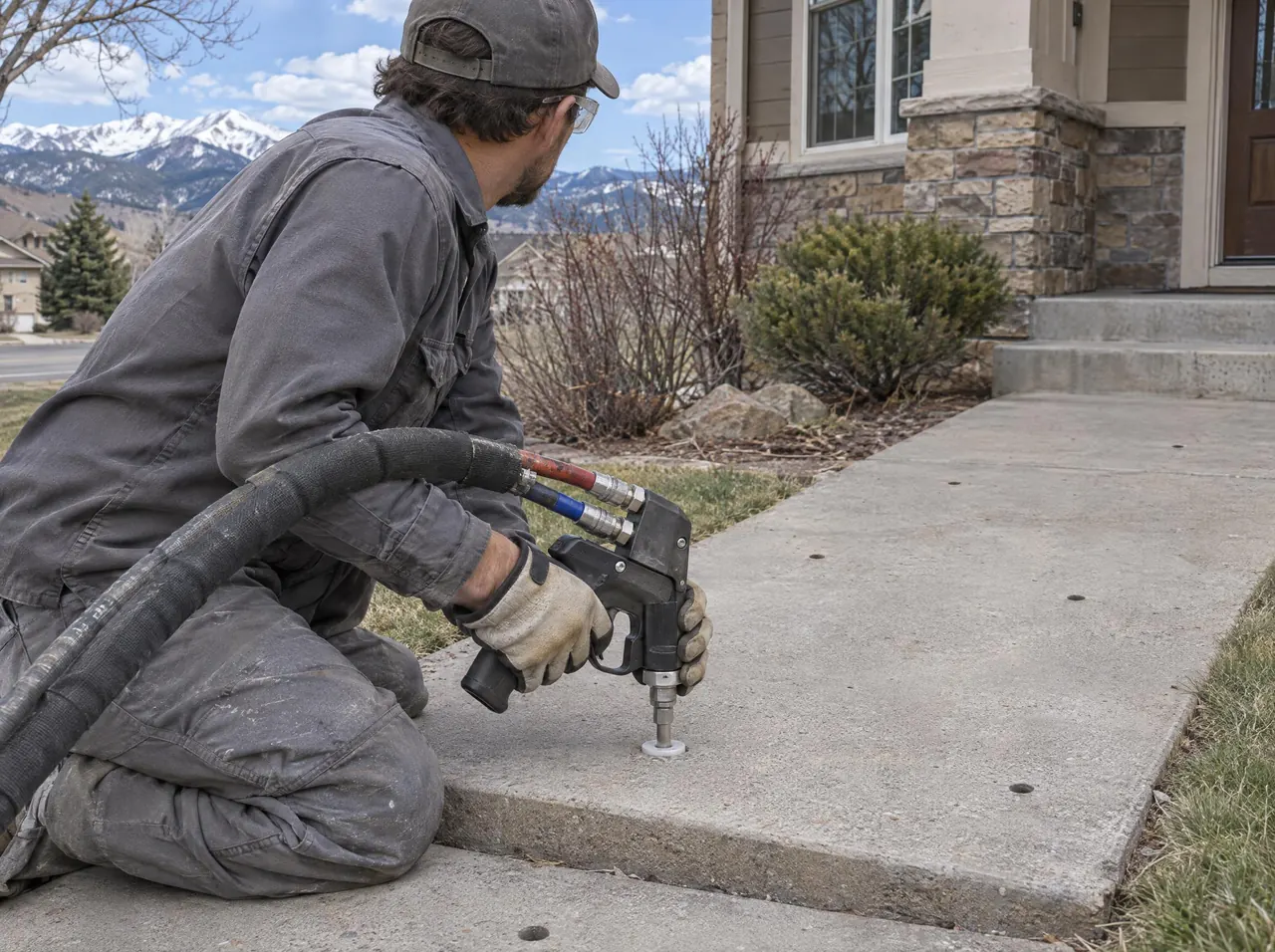
The material starts as two separate liquids, an isocyanate and a polyol resin, kept apart in the rig until they meet in the injection gun. Mixed, they react and expand into a rigid foam. Pumped under a slab, that foam first fills any empty space and then, once the space is full, presses up on the concrete and lifts it.
That's the whole idea behind polyurethane concrete leveling in Denver or anywhere else: controlled expansion in a confined space. The skill is in how much goes in, where, and how fast. Foams are made in different densities for different jobs, and lifting foams are formulated to cure quickly and handle wet soil.
Contractors call it several things. Foam concrete leveling, polyjacking and poly lifting all describe this process, and the differences between companies come down to the foam they buy and how carefully they inject it.
Foam lifting, step by step
1. Measure and plan the lift
Before drilling, the crew measures how far each panel has dropped against the ones around it and looks for what's holding it down: a step overlapping its edge, a heaved neighbor, a downspout that caused the problem. Drains, utility lines and gaps along the foundation get noted, since foam travels toward open space.
2. Drill small injection holes
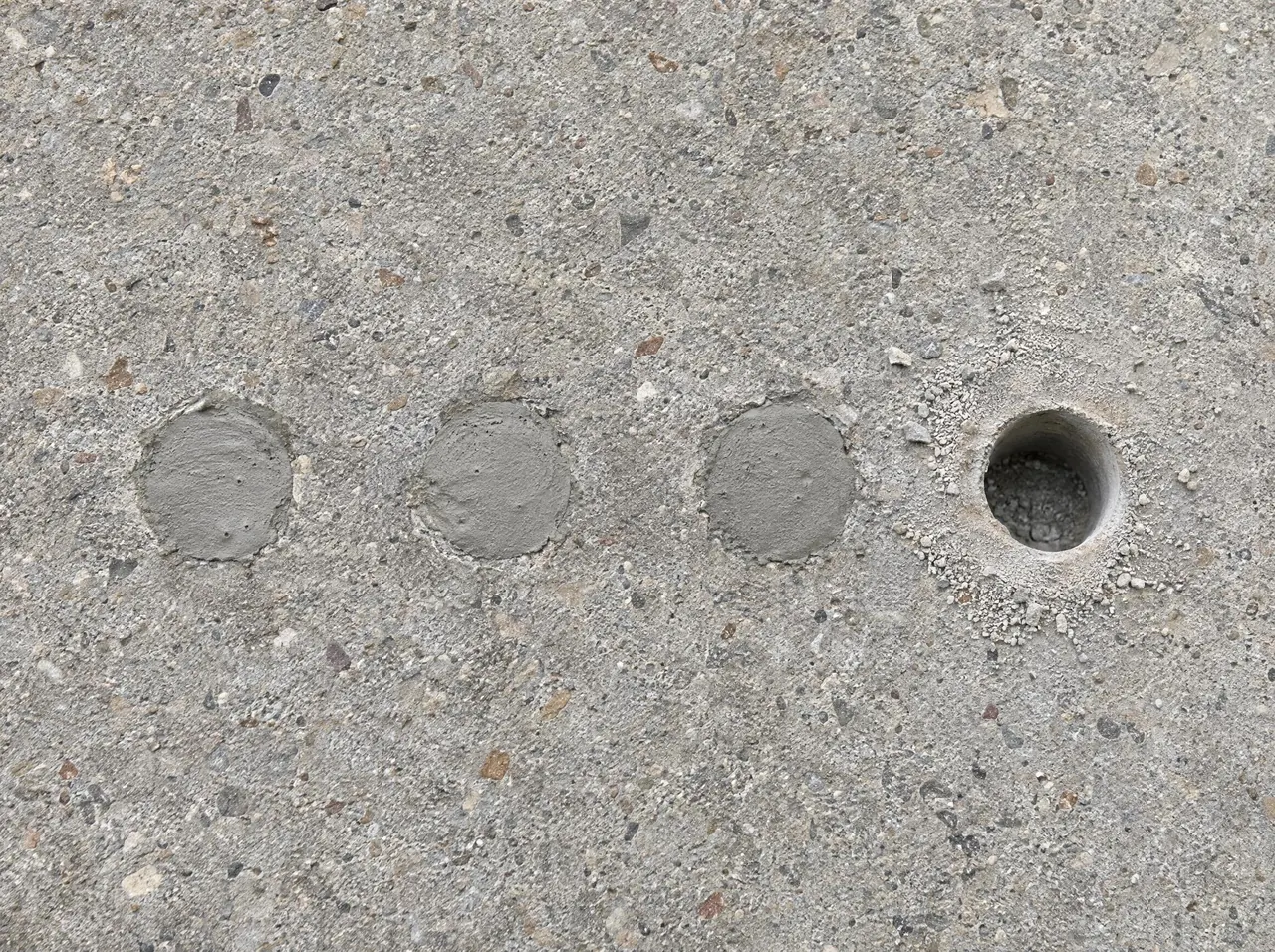
Holes about 5/8 in across go through the slab in a pattern that covers the settled area. The spacing depends on the size of the panel and where the void sits.
3. Set ports and inject in short shots
A port is tapped into each hole and the gun connects to it. Foam goes in a little at a time, and the crew moves from port to port so the panel rises evenly and doesn't tip up at one corner.
4. Watch the level, not the clock
Someone keeps a level, string line or laser on the slab the whole time. Neighboring panels get watched too, because a panel being lifted can pull or push the one beside it.
5. Patch the holes
Once the slab is where it belongs, the ports come out and the holes are filled with a cement-based patch. They stay visible as small circles, a little different in color from the old concrete.
6. Seal the joints
With the panels back in line, open joints and cracks get flexible sealant so water can't run straight back under. The full sequence for a visit, including what to clear before we arrive, is on our how-it-works page.
Where foam does well
- Soft or wet soil, where adding a heavy fill would load the ground that already gave way.
- Slabs people need back quickly, since the panel can usually take foot traffic the same day.
- Places where water keeps showing up, because cured foam doesn't wash out.
- Interior floors and tight spots, where small holes and a hose from the rig keep the mess down. Our page on garage and basement floor leveling covers indoor work in more detail.
- Decorative or exposed-aggregate surfaces, where smaller patches are easier to live with.
Foam is also the usual choice when the job is filling a void under a slab that hasn't dropped yet, because it can be fed in slowly without moving the concrete.
Not sure whether foam is the right fit for your slab? We'll measure it and tell you which method we'd use and why.
Request an estimateThe limits of poly foam slab lifting
Too much foam too fast can over-lift a panel, crack it, or push foam into a place it shouldn't go, such as a drain line or a gap at the foundation. Short shots and constant measuring are what prevent that.
Foam also costs more for the material than slurry does. On a large void, that difference adds up, and it's one of the few situations where mudjacking can come out ahead on a quote.
And foam can't fix what lifting can't fix. A slab broken into several pieces, a panel heaved up by a tree root, or settlement tied to a foundation problem needs replacement, root work or a structural engineer, whichever material is in the gun.
When we choose foam over slurry
We use both methods and pick per job. These are the conditions that push us toward foam.
Foam on Front Range clay
Expansive clay is common under Front Range neighborhoods. It swells when wet and shrinks when dry, which is behind a lot of the settlement on driveways that have dropped at the garage and walks along the house.
Foam fills the gap and lifts the slab without adding much weight to that clay. It doesn't change how the clay behaves, so steady drainage away from the slab is still the best protection against the next drop. Check that your city is on our Front Range coverage map.