Different owners, different concrete
Lone Tree is a compact Douglas County city where I-25 meets C-470, roughly 17 miles south of downtown Denver. Park Meadows anchors its north end, and the newer RidgeGate area spreads out along I-25 to the south. In a small footprint the city holds regional retail, medical offices, hotels, apartments, townhome associations and single-family streets. Each of those owns a different kind of concrete, so concrete leveling in Lone Tree looks different depending on who's asking.
| Property type | Concrete that tends to need attention | What drives the decision |
|---|---|---|
| Retail and restaurants | Walks from parking to entrances, outdoor seating slabs | Foot traffic and trip edges |
| Medical and office buildings | Entrance plazas, drop-off walks | Keeping entrances open while work happens |
| Townhome and condo associations | Shared sidewalks, stoops, garage aprons on private drives | Board approval, budget, many panels at once |
| Single-family homes | Driveways, back patios, front walks | Water draining toward the house, steps at the garage |
The first two rows are covered in depth on our commercial concrete leveling page, including how the ADA thresholds for vertical offsets help managers decide what to fix first.
Measure the offset before anything else
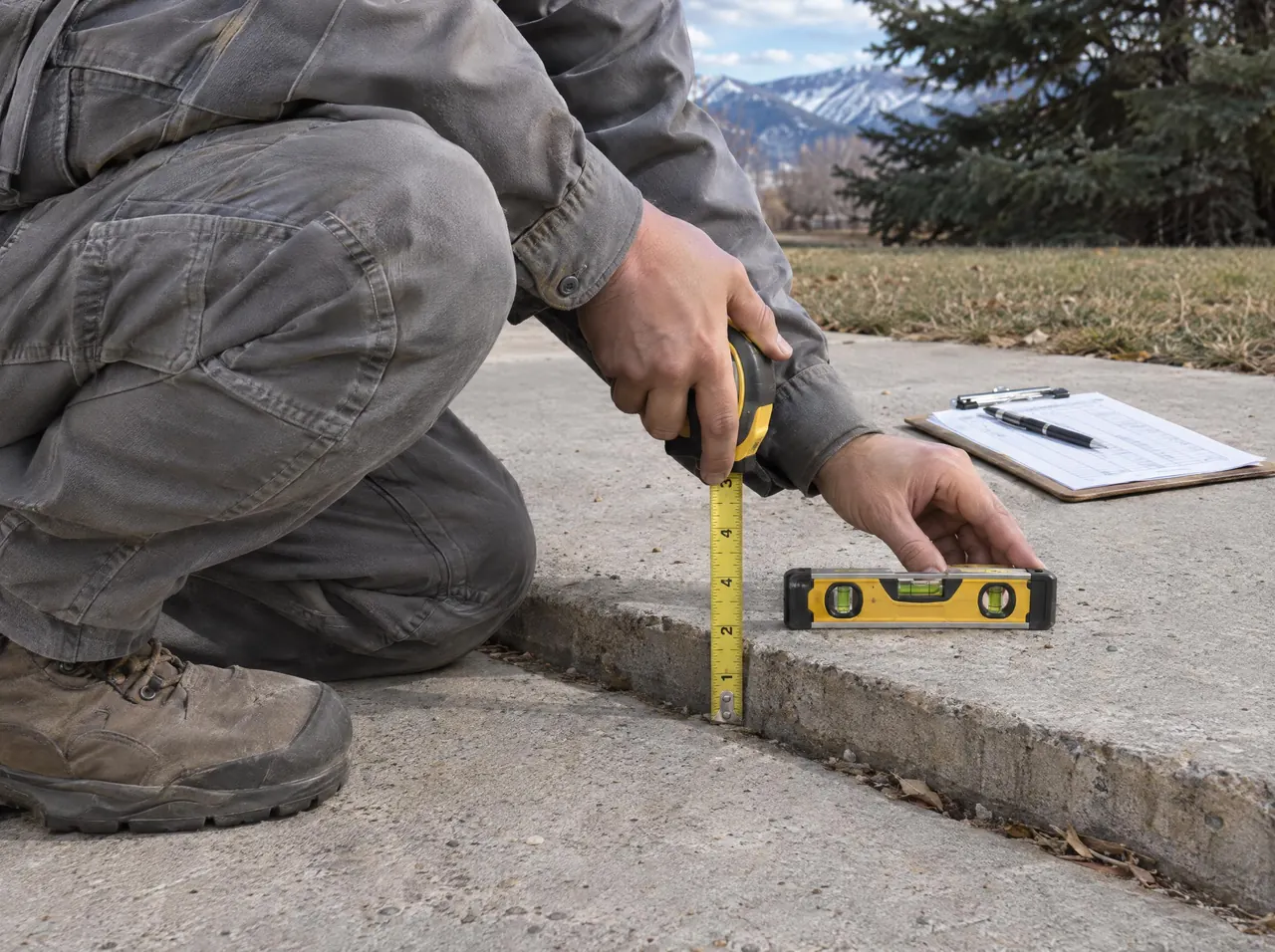
Most decisions about a raised joint come down to one number: how far one slab sits above the other. Measuring takes a couple of minutes and saves a lot of back-and-forth.
- Rest a straight board or level on the higher slab so it spans the joint.
- Measure from the underside of the board down to the lower slab at its worst point.
- Photograph the tape in place, then take a wider shot of the whole slab.
- Tap the low slab with a broom handle; note whether it rocks or sounds hollow.
A hollow sound over one area means empty space underneath. If that slab hasn't dropped yet, void filling can support it before it does.
Send the measurement and photos for each problem slab, and we'll come back with what makes sense to lift.
Request an estimateTownhome associations: map the whole site
Associations tend to call after one resident trips or complains about one joint. Odds are there are others nearby. Walking every shared walk once, marking each offset with its height, and ranking them by severity and foot traffic turns a string of complaints into one planned job. Entrances, mailbox clusters and routes to guest parking go first. That approach also makes the board's budget conversation much easier, since everyone is looking at the same list.
Townhome rows put garage aprons and stoops side by side over the same band of foundation backfill. When one unit's stoop has dropped, check the neighbors' stoops too; they were built on the same fill at the same time.
On busy walks, foam is often the practical choice because a lifted panel can usually take foot traffic the same day. The sidewalk leveling and trip hazard page goes further into reading which side of a joint moved.
Public walks and shared walks
A sidewalk along a public street is a question for the City of Lone Tree; check about responsibility and any approval needed before arranging work in the right-of-way. Walks inside a townhome or condo community usually belong to the association, and walks across a retail or medical campus belong to the property owner, who may be different from the business in the building. On commercial sites, it's worth confirming that before anyone signs off on the work.
Medical offices near Sky Ridge and the stores around Park Meadows share one practical constraint: entrances can't simply close for a day. Work can be split into sections so one side of a walk stays open while the other is lifted.
Newer homes: check the paperwork first
Much of the newest housing in Lone Tree is in RidgeGate, and new construction settles too. Backfill around fresh foundations and utility trenches often hasn't finished compacting when driveways and walks are poured over it. If your home is only a few years old, read your builder's warranty before paying for a repair, since some builders cover flatwork for a set period. If it doesn't apply, a panel that dropped on young concrete is normally whole and lifts cleanly.
Measure, photograph and map before calling anyone. That one step shows if it's a single bad panel or a pattern across the site, and it decides the scope of the job.