A young city with established neighborhoods
Centennial incorporated in 2001, but most of its housing is older than the city. It was formed from Arapahoe County subdivisions that had already been built out, between I-25 and the plains to the east, roughly 15 miles south of downtown Denver. For concrete leveling in Centennial, that history means plenty of driveways and patios that have been through decades of Colorado winters and have settled somewhere along the way.
The single most common request on homes of that age is a driveway. So instead of a general overview, this page follows one drive from the garage door to the street and covers what tends to go wrong at each stop.
At the garage door: the apron drop
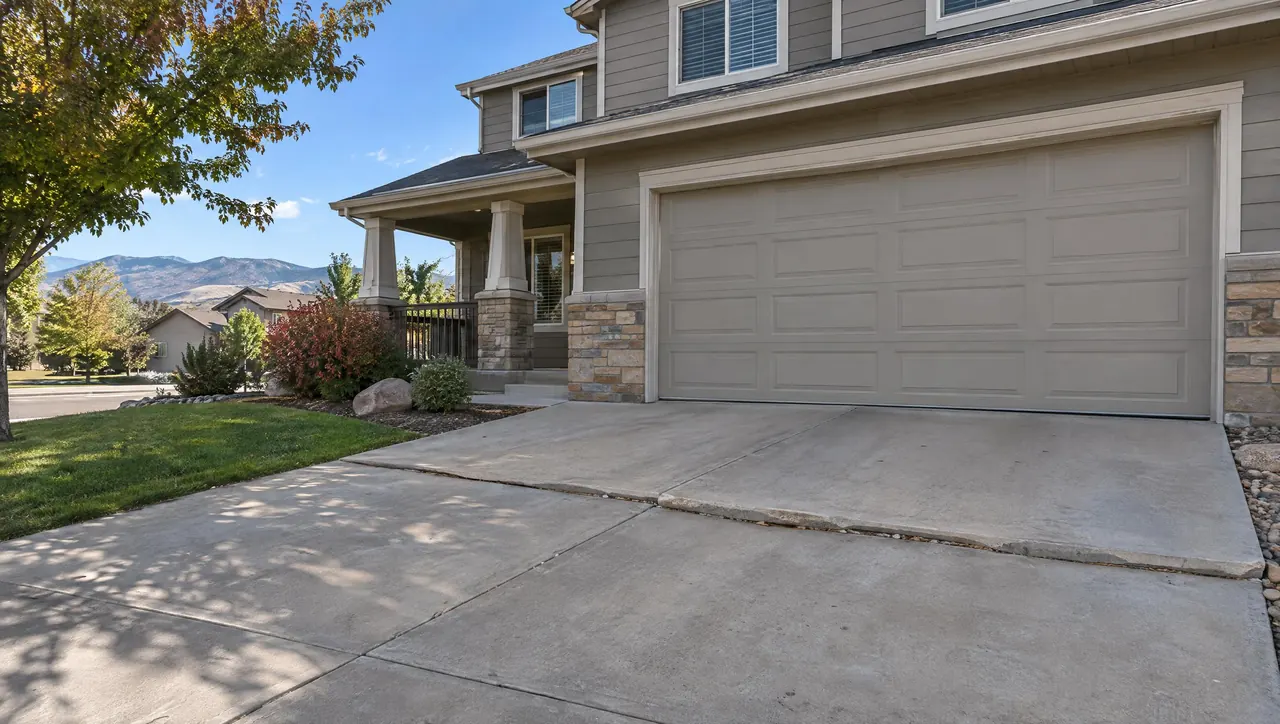
The first panel outside the garage sits on soil that was excavated for the foundation and pushed back in afterward. Backfill like that is rarely compacted as well as the undisturbed ground beyond it, and it keeps consolidating long after the house is finished. The result is a step down from the garage slab to the drive, sometimes with the panel tilted toward the house so meltwater runs back under the door.
That panel is often the best candidate on the whole drive. It usually drops as one piece, and lifting it closes the step and restores the slope away from the garage. Our driveway leveling page has more on apron panels and lips at the garage.
The middle panels: joints and water
A typical residential drive is about 4 in thick, with control joints roughly every 8 to 12 ft (ACI guidance puts spacing at about 24 to 36 times the slab thickness). Each of those joints lets some water through. When one panel in the middle has dropped, look at what's next to it: a downspout splash block, a sprinkler head, a planting bed that stays wet. Fix the water as part of the job, or that panel will likely move again.
| What you see | Likely reason | Usual fix |
|---|---|---|
| Step down at the garage door | Foundation backfill settling | Lift the apron panel |
| One middle panel low on one side | Downspout or sprinkler water at that edge | Lift, then move the water |
| Panel rocks when a car rolls over it | Void under one end | Fill the void and lift |
| Joints wide open, panels still in line | Sealant missing or failed | Joint sealing only |
| One panel broken into many pieces | Load or freeze damage | Replace that panel |
A panel that rocks or sounds hollow but hasn't sunk much is a good case for filling the void under the slab before it cracks under a vehicle.
Tell us which panels moved and roughly how far, and we'll talk through the drive from apron to curb.
Request an estimateWhere the drive meets the sidewalk
The last panel or two usually cross a public sidewalk before reaching the curb. That section is commonly in the public right-of-way, so check with the City of Centennial about who is responsible and whether anything needs approval before it's lifted. The private portion is the homeowner's call. If the sidewalk crossing is fine and only the panels nearer the house have moved, those can be done on their own.
Many neighborhoods here also have HOAs. Leveling restores existing concrete without changing its look, but if your covenants require approval for exterior work, it's simpler to ask before the crew shows up than after.
After the lift: seal what's open
Lifting closes the offsets. It doesn't close joints or cracks, and the drill holes get patched. Joints that are open to the soil should get flexible sealant so snowmelt stops feeding the base all winter; concrete joint and crack sealing is usually the last step of a driveway job. The full leveling process walks through each stage.
On a Centennial driveway, start with the panel at the garage door. It's the one most likely to have dropped, and it decides which way water runs off the slab.