One town across two counties
Windsor sits between Fort Collins and Greeley, east of I-25 along Highway 392, roughly 60 miles north of Denver. Its town limits cross the Weld and Larimer county line, and homeowners sometimes ask whether that changes anything about concrete leveling in Windsor. For the work itself, it doesn't. A settled patio behaves the same way on either side of the line.
Where the line can matter is paperwork. Questions about the public sidewalk in front of a house go to the Town of Windsor, whichever county assessor sends the tax bill. Walks through common areas in a subdivision usually belong to the HOA. And before any digging, even a shallow trench for a downspout line, Colorado 811 will mark buried utilities at no charge.
Downtown Windsor and the newer neighborhoods
The town has a small historic downtown along Main Street, and decades of growth have spread out from it in every direction: lake and golf communities, large HOA subdivisions, and newer phases still filling in. Concrete problems tend to split along the same line.
| Older homes near downtown | Homes built since the 1990s | |
|---|---|---|
| Typical slab age | Decades old, sometimes original to the house | Usually under 30 years |
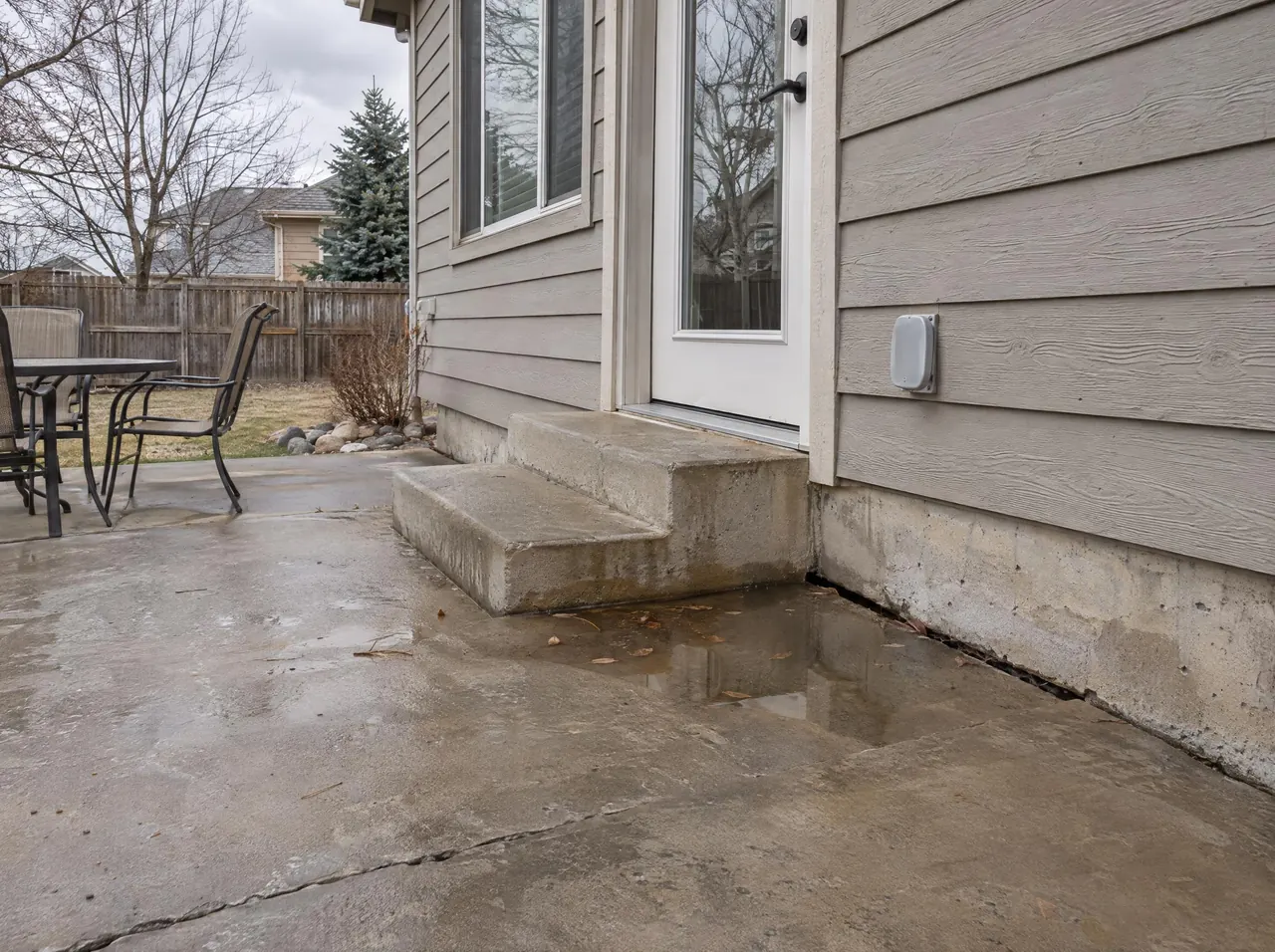
| Common complaint | Front walk panels and steps out of line | Driveway apron dropping at the garage; patio tipping toward the house |
| Usual cause | Years of freeze-thaw and slow erosion of the base; root heave near old trees | Loose backfill against the foundation, plus irrigation and roof water |
| Check first | Did the panel drop, or did something push it up? | Where downspouts and sprinklers send their water |
| Still liftable? | Yes if the pieces are whole; badly broken panels need replacing | Usually, since these slabs tend to be intact |
Deciding what a sunken slab needs
Not every low slab is a lifting job. Sorting them takes a few minutes of looking before anyone drills.
That second case catches people off guard. Water running under a slab can carry soil away and leave a cavity while the concrete above still looks fine. Pumping material into that space (slab void filling) gives the concrete support again while it is still in one piece.
Patios and pool decks out back
A patio pitching toward the house sends rain and snowmelt straight at the foundation. In parts of the Front Range where expansive clay is common, wetting the soil against a foundation is exactly what you don't want, since that clay takes on water and expands, then contracts as it dries out. Raising the low side so the patio sheds water away from the house again is often worth doing for drainage alone, even before anyone trips on it. Our page on raising a settled patio covers stoops and steps too.
Pool decks need more care, because the slab sits right against pool plumbing and the shell. The pool deck leveling page explains how lifting is controlled near the coping.
If a slab at your Windsor home is pitching the wrong way, we can measure the drop and tell you what it needs.
Request an estimateKeeping a lifted slab in place
A lifted patio or walk stays put best when the reason it sank is gone. In Windsor's newer subdivisions, that usually means extending downspouts several feet past the slab and turning sprinkler heads so they stop wetting its edge. Near older homes, it can mean clearing out a low spot where water has collected for years. Sealing the joints after lifting closes another path for water to reach the base.
The county line doesn't change the repair. The age of the house and the path of the water do, so check those first.