Small lots, short walks and old concrete
Englewood borders Denver on the south. Broadway runs through it as the main commercial street, and US-285 crosses it east to west as Hampden Avenue. Much of the housing is older and set on compact lots, often with an alley behind. Concrete leveling in Englewood usually involves short front walks, stoops, single driveways and detached garages, plus storefront sidewalks along Broadway.
Concrete that has been down that long has met most of the usual causes of settlement: downspouts that empty beside the walk, street trees, joints that lost their filler years ago and, in parts of the area, clay that swells and shrinks with the seasons.
Planning around a tight site
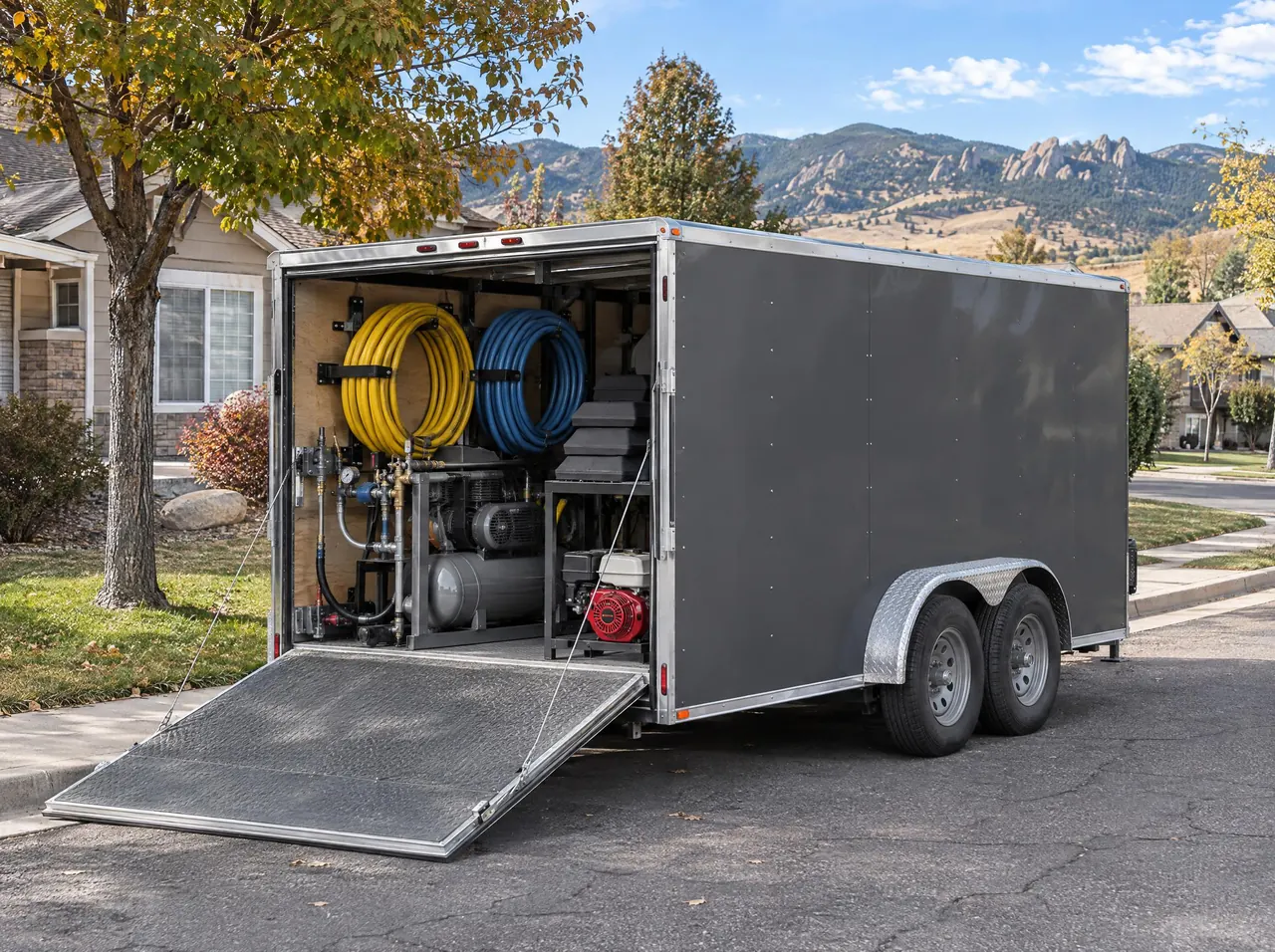
Both foam and mudjacking pump material through hoses from equipment on a truck or trailer. On a compact lot, the useful questions are where that equipment can park and how far it is from there to the slab. A few details help the crew plan:
- Whether the alley or the street is closer to the slab that sank
- Any daytime parking limits on your block
- Gates, fences or narrow side yards between the parking spot and the slab
- Where the downspouts are, since small lots often put them right beside a walk
- Whether a neighbor's walk or driveway meets yours at a shared joint
That last one comes up on narrow lots. If your panel and the neighbor's meet at the same joint, lifting yours changes how the two line up, so it's worth a conversation over the fence first.
Front walks, stoops and the public sidewalk
On an older Englewood house the front walk tends to be short, running from the public sidewalk to a stoop. The stoop rests on fill placed beside the foundation and leans away from the house as that soil compacts. The walk drops at whichever joint takes the most water. Both are good candidates for walkway and sidewalk leveling, provided the slabs are in whole pieces.
Detached garages off the alley
Many older Englewood lots put the garage at the back, reached from the alley, with a short apron between the garage floor and the alley paving. That apron is a common place for a drop. It takes runoff from the alley and the garage roof, and it was often poured separately from the floor, so the joint between them opens over time. A sunken apron can usually be lifted back to meet the floor, and the joint sealed afterward.
The public sidewalk
The public sidewalk along the street is a separate matter. Before paying anyone to work on it, find out from the City of Englewood how that stretch is handled.
Have the walks, stoop and driveway at your Englewood home measured, and tell us how the crew can reach them.
Request an estimateStorefronts and walks near the hospitals
Along Broadway, and around Swedish Medical Center and Craig Hospital, sidewalks and entries carry steady foot traffic, including people using walkers, canes and wheelchairs. A small offset matters more there than on a quiet residential block. The 2010 ADA Standards allow up to 1/4 in of vertical change with no treatment, require a bevel between 1/4 and 1/2 in, and call for a ramp beyond that. We don't give legal advice, but those numbers are a sensible way to decide which entry to fix first.
With foam, a lifted walk is typically open to people again the same day, which suits a business that can't close its door for long. Our commercial leveling page covers how storefront and office walks are scheduled. Property a little further south along Broadway falls under our Littleton concrete leveling page.