A young town with young concrete
Firestone is a Weld County town along I-25, about 30 miles north of Denver, in the area known as the Carbon Valley with neighboring Frederick and Dacono. It began as a small coal town, but most of today's homes are in subdivisions built since the late 1990s, many with HOAs, on what used to be farmland. The concrete around them is fairly new.
That surprises a lot of people who end up looking for concrete leveling in Firestone. The slab itself is often fine. What moved is the ground under it: soil disturbed and refilled during construction, then softened by sprinklers and downspouts and worked on every winter.
What each season does under a slab
Front Range weather swings hard, and each season leaves its own mark on concrete sitting over young fill.
| Season | What's happening underneath | What to look for |
|---|---|---|
| Winter | Water in the soil freezes and expands, then thaws, often many times between storms | New cracks; joints that open wider in a cold snap |
| Spring | Quick snowmelt and storms soak the soil next to the house | Fresh drops at garage aprons and stoops; puddles that linger |
| Summer | Dry heat, with daily irrigation keeping some edges wet while others dry out | One side of a walk or patio sinking along the lawn |
| Fall | Sprinklers shut off and the ground dries before the first hard freeze | A good time to measure what moved over the year |
Driveway aprons and garage floors
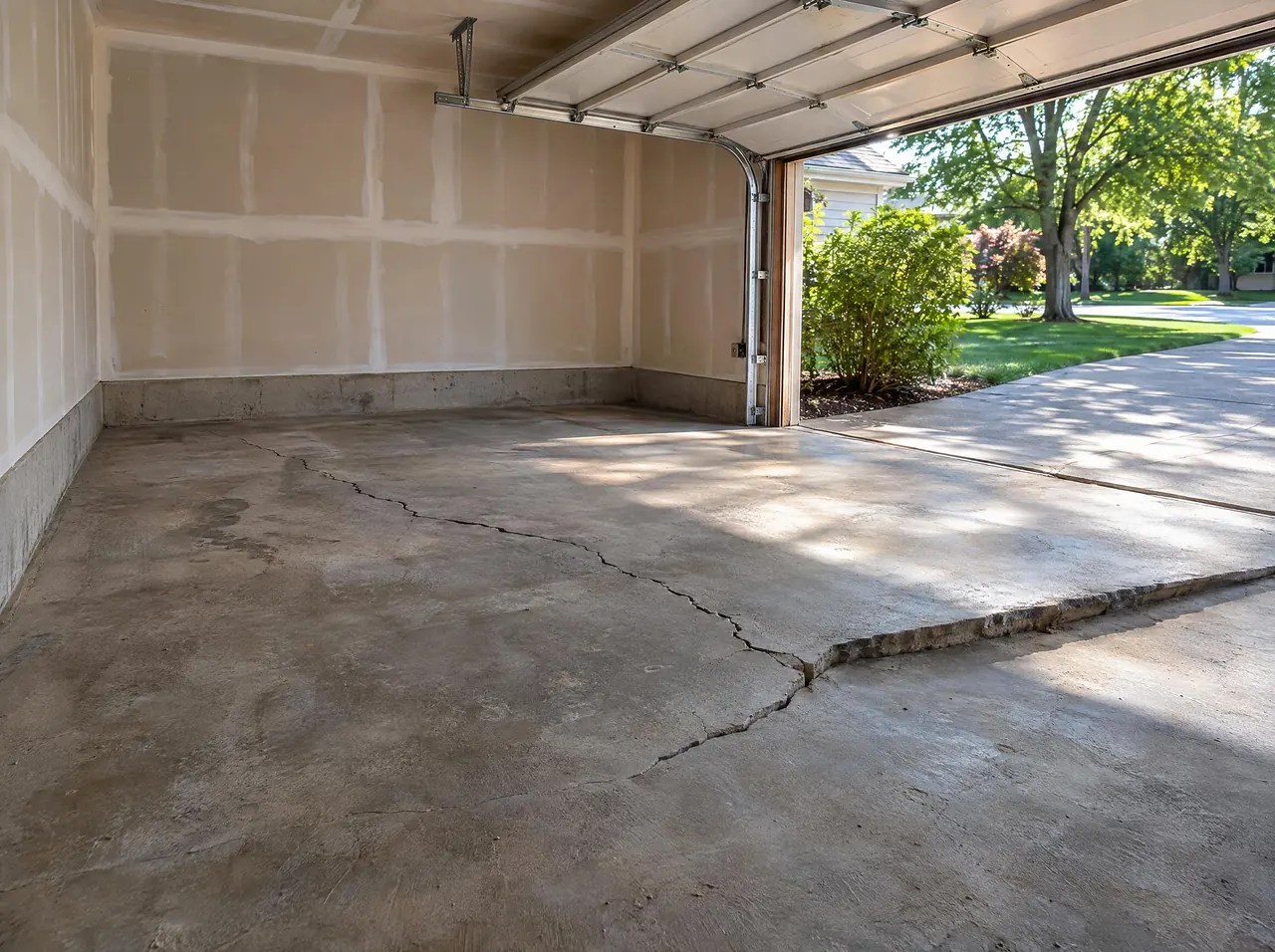
The most common complaint in Firestone's newer neighborhoods is a drop where the driveway meets the garage. Inside, the garage floor itself can sink near the door or along a wall, especially where snow melting off vehicles collects all winter and finds its way through cracks and joints.
Interior slabs can usually be lifted from inside the garage; our garage slab leveling page explains how. For the outside slab, our driveway lifting service page covers how the crew chooses between foam and slurry.
A garage floor is meant to slope gently toward the door so meltwater runs outside. If a section near the back wall dropped and now holds meltwater, lifting it restores that fall. A floor that sank along with cracks in the foundation wall beside it needs a structural engineer first.
If your Firestone driveway or garage floor has started to drop, a measurement tells you how far and whether lifting fits.
Request an estimateWhat lifting a driveway apron involves
For a typical sunken apron, the crew measures the drop against the garage slab and the panels beyond it, then drills a pattern of holes through the low section. With foam, those holes are about 5/8 in; with mudjacking, roughly 1 to 2 in. Material is injected in small amounts and the rise checked as it goes, stopping once the apron meets the garage floor and drains away from the door. The holes are patched, and the joint between the apron and the garage floor can then be sealed. Our leveling process page walks through each stage.
HOA boards and shared walks
Most subdivisions here have an association, and the walks along parks, trails and open space are usually its responsibility. For a board looking at a long list of trip edges, measuring the whole site first makes budgeting easier and puts the worst offsets at the top. The sidewalk leveling page explains how individual panels are lifted back to flush.
Homeowners lifting their own driveway or patio should still read the covenants. Some associations ask for notice before any exterior work, even when nothing about the look of the house changes.
The coal mining question
Parts of the Carbon Valley were mined for coal long before the subdivisions arrived. Our Frederick page explains why that matters for a small number of properties and what concrete leveling can't do about it.
Settling in Firestone usually comes from the fill around new houses plus too much water. Deal with downspouts and sprinklers, then lift the slab.