Commercial concrete in Commerce City: entries, walks and yards
Commerce City sits northeast of Denver where I-270, I-76 and US-85 come together, and its older southern end is largely industrial: warehouses, distribution buildings, truck yards and the refinery near the South Platte. For a lot of owners here, concrete leveling in Commerce City means a commercial site, where a sunken panel at the front door is a liability question as much as a looks one.
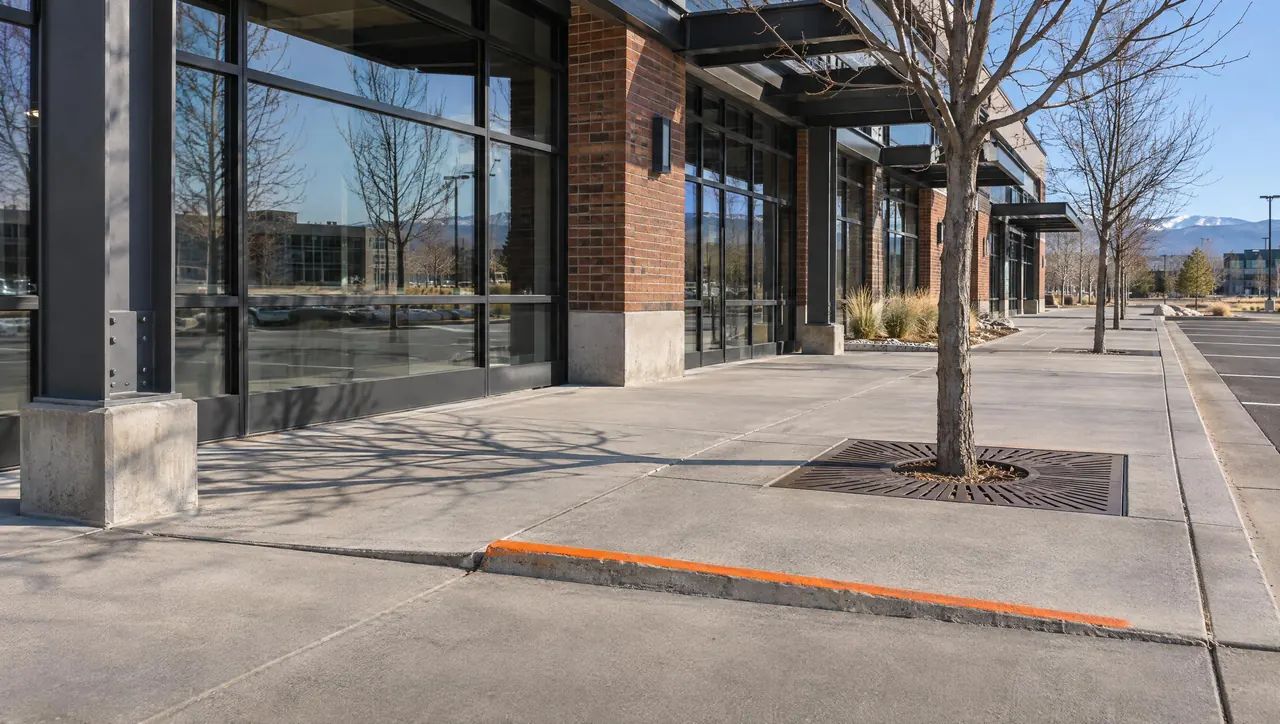
The slabs people trip on are usually outside the building. Think of the walk from the parking lot to the office door, the apron where a sidewalk meets a drive, or the slab beside a downspout that has dumped roof water in the same spot for years.
How big an offset has to be before it matters
The 2010 ADA Standards set limits on vertical changes in level along walking surfaces. For a property manager walking a site, those limits double as a sorting tool:
| Offset at the joint | 2010 ADA Standards | Practical response |
|---|---|---|
| 1/4 in or less | Permitted as is | Recheck it each spring, and seal the joint to keep water out |
| Between 1/4 and 1/2 in | Edge must be beveled at 1:2 or flatter | Raise the sunken side so the edge disappears instead of grinding a bevel |
| More than 1/2 in | Has to be treated as a ramp | Schedule it first; this is the edge people catch a toe on |
That summarizes one section of the standards and isn't legal advice. It does give a manager a fast way to rank a list of entries across several buildings. Our commercial concrete leveling page explains how work is scheduled around tenants and customers.
Warehouse floors, yards and dock approaches
Heavier slabs need a different read. A forklift aisle or a truck apron carries loads a house driveway never sees, so before anyone talks about lifting, the crew checks how thick the slab is, whether the joints have broken down, and whether a panel is truly lower or just rocking over a void.
Homes in Reunion and the north end
North of the Rocky Mountain Arsenal National Wildlife Refuge, Commerce City looks like a different place. Master-planned neighborhoods such as Reunion have filled in over the past couple of decades, with HOAs, attached garages and concrete patios out back.
Problems there look like any newer suburb on the Front Range: a patio sinking toward the back door, a stoop separating from the house, a lip forming where the drive meets the garage. The builder's backfill around the foundation is still consolidating, and lawn watering every summer hurries it. Driveway leveling and patio work at a newer home is often a good fit for foam, because the fill is soft and most owners want the slab back in use quickly.
Get every entry and walkway at your Commerce City property measured and ranked by offset.
Request an estimateWhat to sort out before the crew arrives
- A site map or list marking each problem area, with the worst ones flagged
- The hours when foot or forklift traffic is lightest
- Where a truck and trailer can park near each area
- Any irrigation lines, conduit or snowmelt tubing known to run under the slabs
- Who on your side can approve added work if the crew finds a hollow slab next to one on the list
Dock approaches deserve their own note. The joint where an exterior apron meets the building takes runoff, truck tires and plowed snow all winter, and once its sealant fails, water goes straight into the base. After any lift, joint sealing along that line is cheap protection for the work.
Buried lines matter for anything that follows the lift. If regrading or a downspout trench is part of the fix, have Colorado 811 locate the lines before a shovel goes in.