Walk the property one slab at a time
Concrete leveling in Lafayette starts with something any owner can do in fifteen minutes: walk around the house and look at each slab on its own. Most properties have four or five pieces of flatwork, and they rarely fail for the same reason. Going in the order you'd walk in from the street keeps it simple.
The front walk
Stand at the street end and sight along the walk toward the door. A dropped panel shows as a dip; a lip at a joint shows as a thin shadow line in low morning or evening sun. In Old Town, along and off Public Road, walks are often older than the house's last remodel and may have been patched more than once. Note any panel broken into several pieces, because those aren't lift candidates. For the public sidewalk at the curb, check with the City of Lafayette about who maintains it.
The porch and steps
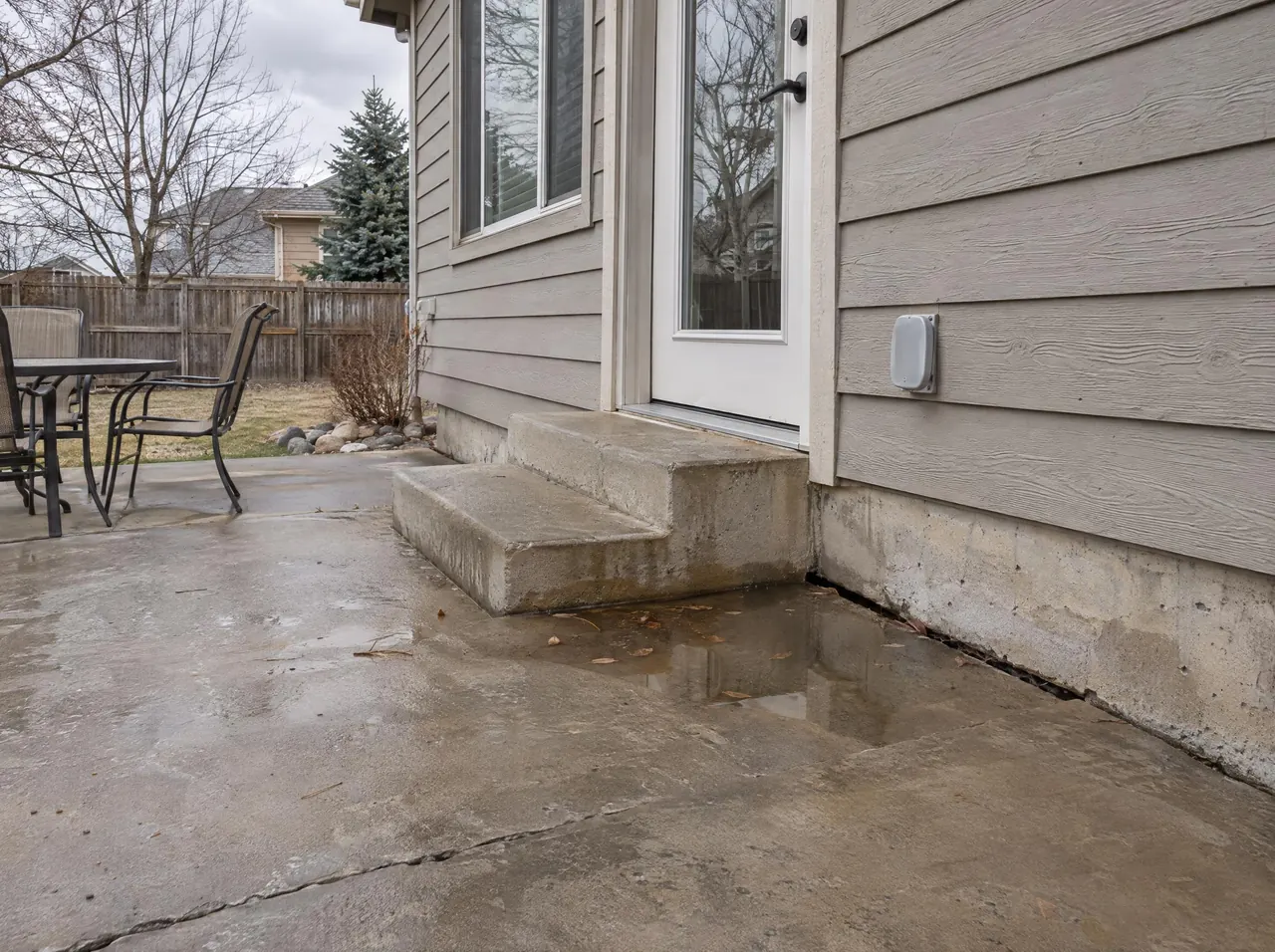
Lafayette began as a coal mining town in the late 1800s, and many of its small early houses have short concrete stoops that were added or replaced long after the house was built. Look at the gap where the stoop meets the wall. If it is wider at the top than at the bottom, the stoop has rotated outward over soft fill against the foundation.
The driveway
Check two spots: the apron where the driveway meets the garage, and the joint where it meets the sidewalk. Both are common low points. If meltwater now runs toward the garage door, the first panel has dropped.
The back patio
Pour a bucket of water on the patio near the house and watch where it goes. If it heads for the foundation, the slab has tipped back. Deal with this one first, since it sends roof and lawn water straight at the basement wall. The patio leveling page covers how a tipped slab is lifted back to a slope that drains.
Inside the garage
Garage floors move less often. Tap any cracked section with a hammer handle anyway; a hollow sound means a void below.
Match the fix to what you found
Front walks with a single raised joint are the most straightforward of these. The page on leveling a sunken front walk explains how the low panel is brought back flush.
Write down what you found, with a tape measurement at each lip and a photo of each slab. That list gives whoever looks at the job far more to go on than a description over the phone.
Old Town and the newer subdivisions settle differently
Lafayette's housing splits roughly in two. The older core around Public Road has small lots, mining-era cottages and mid-century homes, with concrete that has had decades to find its level. Settlement there tends to be slow and local, usually traceable to one downspout or a leaking hose bib. Growth since the 1990s added much larger subdivisions, including the neighborhoods around the Indian Peaks golf course, where the concrete is younger and the usual cause is foundation backfill that is still consolidating.
That split changes the advice. On an older slab that settled slowly, a lift tends to hold once the water source is dealt with. On younger concrete, the age of the house matters: fill that went in only a few years ago may keep moving slightly, and a lightweight lifting material adds the least load to it. Our driveway lifting page walks through the apron problem that shows up on so many newer garages.
Bring your walk-around notes and have each slab measured to see which ones can be lifted.
Request an estimateThe city sits east of Boulder near US-287, about 25 miles north-northwest of downtown Denver, between Louisville and Erie.