Tell a settled slab from moving ground
Most concrete leveling in Erie is ordinary flatwork repair: a driveway panel that dropped at the garage, a front walk with a lip at one joint, a patio tipping toward the back door. Those slabs sank because the soil directly under them softened, washed out or was never compacted well. Lifting them with foam or mudjacking puts them back where they belong.
The town has one piece of history worth knowing. Erie began as a coal mining town, and old underground workings from the Boulder-Weld coal field lie beneath parts of the area. The Colorado Geological Survey has studied subsidence over abandoned mines in that field. We are not suggesting a sunken front walk has anything to do with it; loose fill and water explain nearly all of the settled concrete you'll see. It is simply a good reason to look at the whole pattern of damage before calling something a slab problem.
| What you notice | Points toward | Next step |
|---|---|---|
| One or two panels low, their neighbors flat | Soft or washed-out soil under those panels | Slab leveling |
| Driveway dropped only at the garage apron | Backfill along the foundation settling | Leveling, sometimes with void filling |
| Slab sounds hollow when tapped but hasn't moved | A void forming underneath | Fill the void before the slab cracks |
| Wall cracks, sticking doors, slabs and foundation all shifting | Movement beyond the flatwork | A structural or geotechnical engineer first |
| A depression in the yard that keeps spreading | Ground movement of unknown cause | Professional evaluation before any slab work |
The first three rows are what leveling was made for. The last two aren't, and lifting a slab over ground that is still moving only buys time.
Settlement that crosses several unrelated surfaces at once, such as the driveway, the foundation and the lawn, deserves an engineer's opinion on the ground before anyone pumps material under a slab. If what we see on site points that way, we'll say so.
Where concrete tends to drop in Erie
Old Town around Briggs Street
The blocks near Briggs Street hold Erie's oldest homes. Walks and steps there have had decades to settle, and many have been patched or partly replaced, so one front walk can be three different ages of concrete. Older stoops often lean away from the house as soil beside the foundation slumps. Lifting a stoop back against the wall and sealing the gap is usually simpler than rebuilding the steps.
Subdivisions built since the late 1990s
Most of the town's housing is far newer. Large subdivisions spread across both the Boulder County and Weld County sides through the 2000s and 2010s, and building hasn't stopped. In these neighborhoods the pattern repeats from house to house. Soil excavated for the basement goes back against the foundation, the flatwork is poured on top, and that fill keeps compacting under its own weight and every season of lawn watering. The driveway apron, the front stoop and the patio off the back door all sit on that strip.
Irrigation speeds it up. Summers here are dry, sprinklers run hard, and a head that overshoots onto a slab edge night after night softens the base faster than rain does.
The driveway lip at the garage
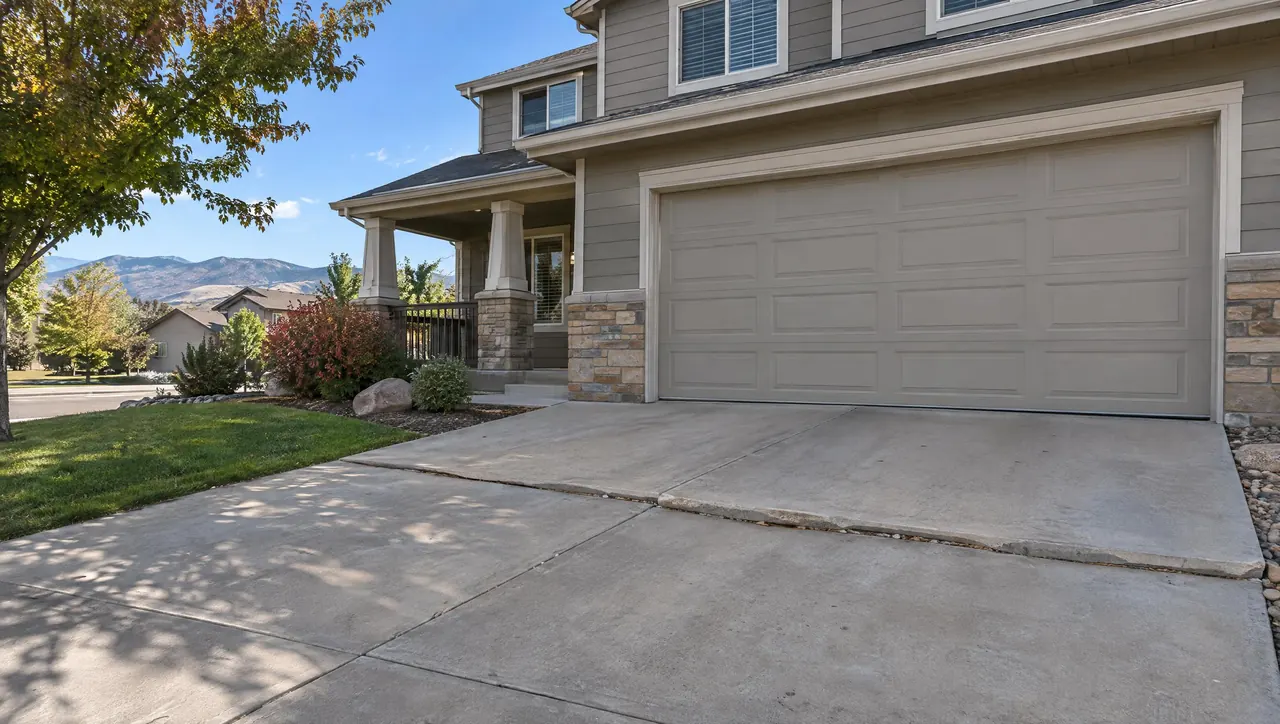
A driveway that has dropped where it meets the garage slab is the classic newer-home complaint. Water starts running toward the garage, and the lip catches snow shovels and scrapes low bumpers. The garage floor usually sits on better-compacted ground and holds its position; the first driveway panel is the one that moved.
Foam is often the better fit for that panel. It goes in through holes about 5/8 inch wide and weighs very little, so it adds almost no load to fill that is still compressing, and the driveway can usually take foot traffic the same day. Mudjacking can lift a driveway too, with a lower material cost, but the slurry is heavy and needs more curing time before you park on it. Our driveway leveling page compares the two on driveways specifically, and the foam lifting method has its own explainer.
Have the dropped panel measured and find out whether it is a straightforward lift or a sign of something bigger.
Request an estimateBefore any work starts
- Have utility lines located through Colorado 811 before any digging that goes with the job, such as trenching for a downspout extension.
- Read your HOA's rules if the slab is a shared walk or anything the association maintains. Many subdivisions in town have one.
- For the public sidewalk along the street, ask the Town of Erie whether its upkeep falls to you or to the town.
- Note which sprinkler zones hit the slab and fix the overspray around the time of the lift.
- Tap suspect areas with a hammer handle. A hollow spot that hasn't dropped yet is a candidate for slab void filling before it cracks.
Erie sits roughly 25 miles north of downtown Denver, between Boulder and I-25, with Coal Creek running through town. Neighbors Lafayette and Broomfield share a lot of the same housing patterns.