A city built mostly in the 1960s and 1970s
Northglenn was laid out as a planned community beginning in 1959 and incorporated as a city in 1969. Most of its houses are ranches and bi-levels from those first two decades, on curving residential streets along I-25 about 10 miles north of downtown Denver. That gives concrete leveling in Northglenn a particular character. Much of the flatwork is original, or close to it, and has been through more than 50 Colorado winters of freeze-thaw, snow and quick melts.
Old concrete isn't automatically bad concrete. A slab that has stayed in one piece for that long is often a good lifting candidate. What age changes is the list of things to check before anyone drills. Street and yard trees planted when these neighborhoods were new are now mature, so it pays to confirm a raised edge isn't a root pushing a panel up before treating it as settlement.
Reading an older slab
| What you see | What it usually means | Can it be lifted? |
|---|---|---|
| One panel low at a joint, otherwise intact | Soil under it settled or washed out | Yes |
| A crack straight across, both halves solid | Normal on older slabs, often where a joint was needed | Usually, lifting both halves together |
| Round patched holes, 1 to 2 inches across | An earlier mudjacking repair | Often; see below |
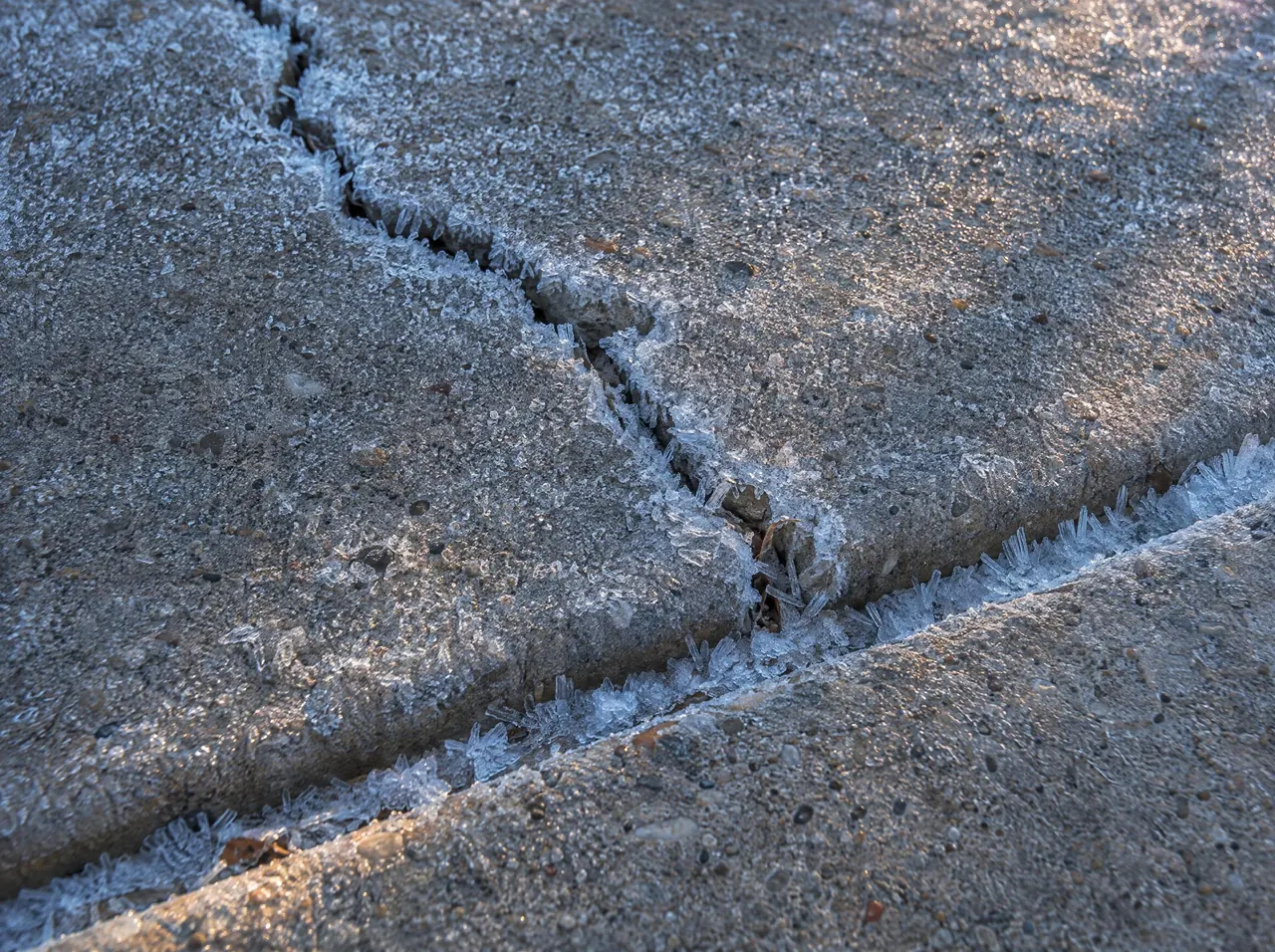
| Surface flaking or scaling | Freeze-thaw and de-icer damage to the top layer | Lifting won't change the surface |
| Many cracks and loose pieces | The slab has broken up | No; replace it |
| Panel raised above the others beside a tree | Root heave | No; root work and new concrete |
Joint spacing tells you something too. ACI guidance puts control joints at roughly 24 to 36 times the slab thickness, or about every 8 to 12 feet on a 4-inch slab. Older driveways sometimes have fewer joints than that, so they crack between joints on their own. A clean crack that now behaves like a joint can be lifted and sealed like any other.
Slabs that were mudjacked before
If you bought an older house, look for signs that a slab was lifted in the past: patched holes roughly 1 to 2 inches across, often in a loose grid. A slab that sank again after mudjacking usually tells you the cause kept working after the first repair. The usual suspects are a downspout emptying at the slab edge, a leaking hose bib or a sprinkler line with a slow leak.
A previously mudjacked slab can usually be lifted again. Foam is sometimes the easier choice, because it fits through small holes between the old patches and adds very little weight on top of the slurry already there. Mudjacking remains an option as well; the mudjacking page explains where the cement-based method is still the right call.
Fix the water source before a second lift. A slab that has dropped twice over the same downspout is likely to drop again if nothing changes.
Have your older driveway or walk measured and find out whether a second lift makes sense.
Request an estimateEntry steps, driveways and the gap at the house
On a bi-level, the front entry is usually a short run of concrete steps up to a small landing. As the soil beside the foundation slumps, those steps lean outward and a gap opens at the wall. Lifting them back and sealing the gap keeps meltwater from running down the foundation. Driveways from this era usually run straight from the street to an attached garage, and the panel next to the garage tends to settle first. Our page on lifting a sunken driveway covers that pattern in detail.
After any lift on older concrete, sealing the joints and cracks is a small extra step that pays off every winter, since open joints are where water gets in. See sealing concrete joints and cracks.
The City of Northglenn can tell you who handles the public sidewalk along your street. Thornton, which borders Northglenn on several sides, has a similar mix of older homes in its south end.