Older south, newer north: where Westminster slabs move
Concrete leveling in Westminster usually starts with the age of the house, because the city filled in over several decades. The southern neighborhoods around the older core near 72nd Avenue were mostly built long ago. Much of the city further north and west, around Standley Lake and up past 120th Avenue, came later, as subdivisions and townhome communities.
The two ages fail differently. Older slabs have had decades of freeze-thaw, root growth and irrigation working on them. Newer ones often sit on fill that hasn't finished compacting. Knowing which kind you have tells us where to look first.
| Older southern neighborhoods | Newer northern subdivisions and townhomes | |
|---|---|---|
| Slabs that move most | Front walks, original driveways, and patios poured long after the house | Patios and stoops against the foundation, the garage apron |
| Usual cause | Long exposure to downspout water, roots and joints that lost their sealant | Backfill near the foundation still settling, sprinklers aimed at slab edges |
| What we check first | Whether a panel sank or was pushed up by a root | Whether the slab now pitches water at the house |
| Who decides | Usually the homeowner | The homeowner, or the HOA for common areas |
Both columns share the Front Range basics. Snow melts in the afternoon sun and refreezes overnight, irrigated lawns keep the soil wet all summer, and expansive clay is common in parts of the metro. Any of the three can open a void under a slab.
Follow the water before lifting anything
Standley Lake sits on the city's west side and Big Dry Creek runs northeast through it, but the water that sinks a patio is almost always closer to home. Look within a few feet of the concrete:
- A downspout that empties at the corner of the patio
- Sprinkler heads that wet the slab edge every night in July
- A lawn graded so it drains toward the walk
- An open joint between the patio and the house wall
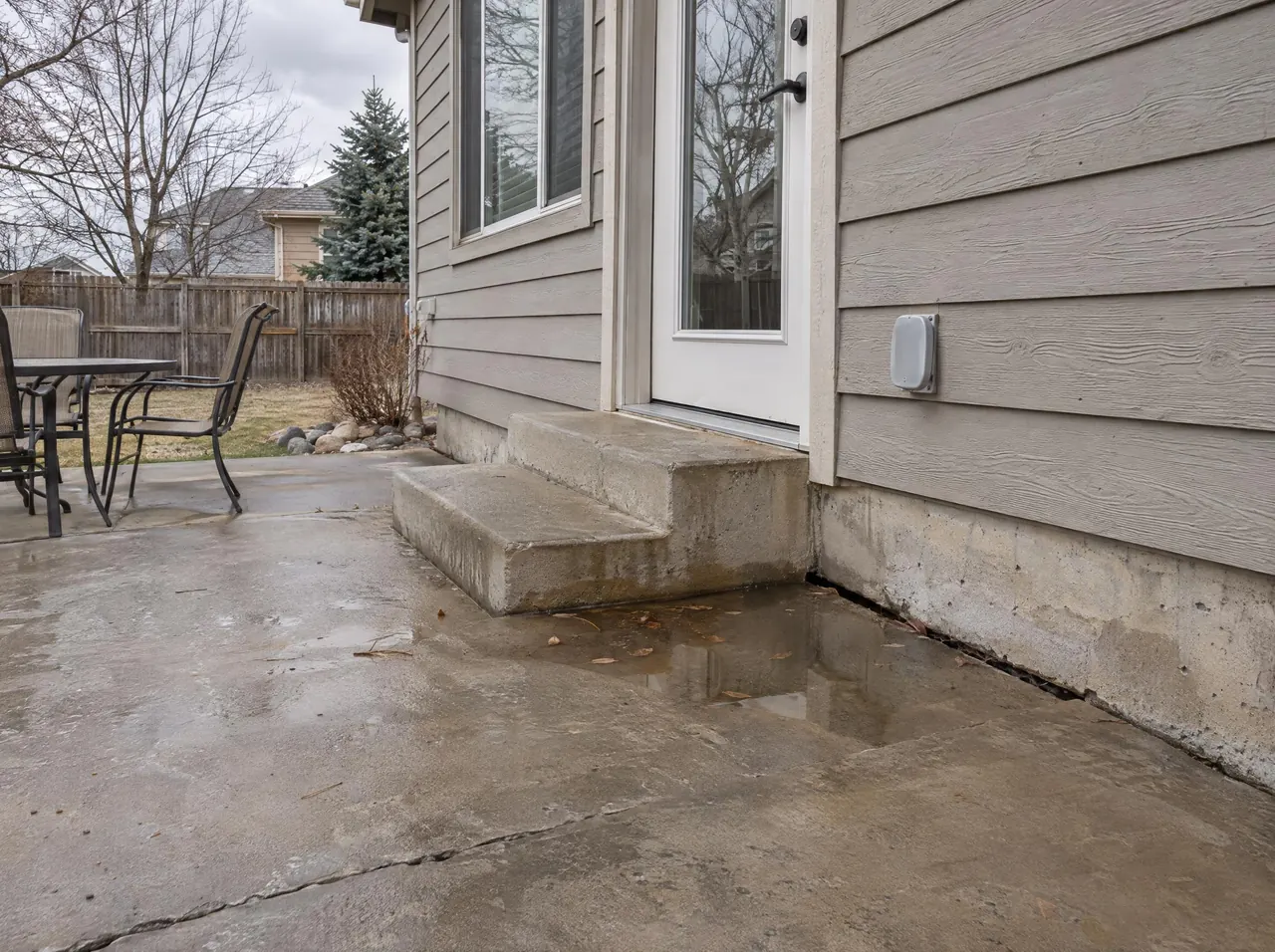
Water that runs off a slab and down that joint softens the soil underneath and slowly carries fine material away. You end up with a void and a slab that has nothing holding up one edge. Lifting fills the void, but if the water keeps coming, the soil keeps moving. Redirect the downspouts and sprinklers first, then seal the joints once the slab is back at height.
A patio that now slopes toward the house is the one we'd move to the top of the list, since every storm sends water straight to the foundation. Patio and stoop leveling can restore the pitch so water runs out to the yard.
Townhome and HOA concrete has a different decision-maker
Plenty of Westminster's newer housing is townhomes and patio homes run by associations. In many of those communities the walks, shared drives and sometimes the front stoops belong to the HOA, while the back patio belongs to the owner. The line is drawn in each community's declarations, and it isn't drawn the same way everywhere.
If the sunken slab is common area, take it to the association or its management company; they can approve the work or schedule a whole building at once. If the slab is yours, tell the HOA anyway, since some communities ask owners to clear exterior work. Boards weighing several buildings at once can find more on measuring and ranking walks on our sidewalk trip hazard page.
Have the patio, walk or driveway at your Westminster home measured before you plan around it.
Request an estimateChoosing foam or slurry for the slab you have
We use both polyurethane foam and mudjacking. At a newer home with soft backfill along the foundation, foam's light weight counts for a lot, because that soil has already shown it can't carry much. Under an older driveway where a large cavity has opened above firm soil, slurry can be the sensible choice with a lower material cost, provided you can keep cars off it while it cures.
Some slabs call for neither. A slab broken into many pieces, a panel a root has raised, or a stoop moving along with a cracked foundation wall needs replacement, root work or a structural engineer before anyone lifts it.
In the older parts of Westminster, first ask whether the panel sank or heaved. In the newer subdivisions, start with the slope of the patio and where the downspouts empty. Those two answers settle most of the job.