Follow the water before lifting anything
Parker sits southeast of Denver, roughly 25 miles out along Parker Road (State Highway 83) and E-470, with Cherry Creek running north through town. Most of the Town of Parker was built from the 1980s onward. The result is a lot of neighborhoods where houses, driveways and patios are all about the same age and were graded the same way.
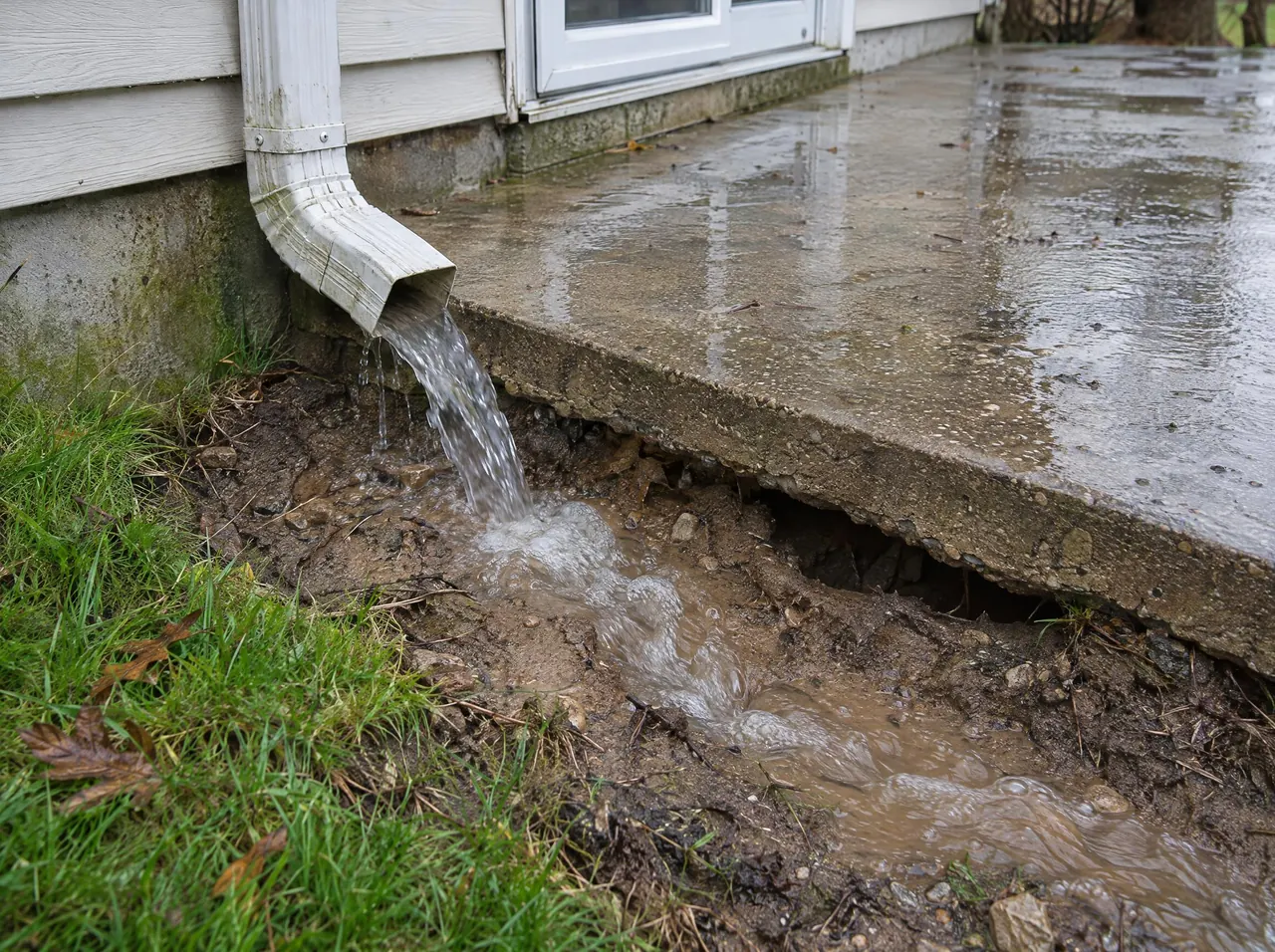
On lots like that, slab settlement usually traces back to water, foundation backfill, or both. So concrete leveling in Parker starts with a walk around the house to see where roof runoff, sprinklers and snowmelt end up. Lifting a slab without dealing with the water usually means lifting it again.
| Water source | What it does to the slab nearby | Fix alongside the lift |
|---|---|---|
| Downspout dumping beside a walk or patio | Softens or washes out soil at one corner; that corner drops | Extend or reroute the downspout |
| Sprinklers spraying slab edges | Keeps edge soil wet all summer; slab tilts toward the lawn | Adjust heads and spray patterns |
| Patio pitched toward the house | Sends water to foundation backfill, which settles further | Lift to restore fall away from the wall |
| Open joints and cracks | Lets snowmelt reach the base all winter | Seal joints after lifting |
| Swale between lots filled in or blocked | Water pools along a walk or driveway edge | Restore the swale (a landscaping job, not ours) |
Why newer lots settle early
New homes often show settlement within their first several years. Soil dug out for the basement is pushed back against the foundation walls, and that backfill is looser than the undisturbed ground around it. Driveway aprons, stoops, front walks and back patios all rest partly on that band of fill. As it consolidates, especially after it's been soaked a few times, the slab edge nearest the house goes down.
This kind of settlement tends to slow once the fill has finished compacting. A slab lifted after that point, with the water sorted out, has a good chance of staying where it's put. See our driveway leveling service for apron drops at the garage, and the patio and stoop leveling page for slabs at the back of the house.
Watch where the water goes during the next storm, then tell us which slab dropped; we'll help you sort the lift from the drainage fix.
Request an estimateHollow slabs that haven't dropped yet
Washout doesn't always show up as a drop right away. The soil goes, but the slab bridges the gap for a while, held up by its neighbors and its own stiffness. Tap a suspect slab with the end of a broom handle and listen. A dull, drum-like sound over one area means empty space below. That's the stage where filling voids under the slab is the smaller fix, before the slab cracks under a vehicle or a loaded wheelbarrow.
A Parker mailing address doesn't always mean the Town of Parker. Some neighborhoods with Parker addresses are in unincorporated Douglas County. For a sidewalk in the public right-of-way, confirm which one your lot is in and contact that office before any work.
The order that keeps a lift in place
On a typical Parker lot with more than one problem slab, sequence matters more than the material. A sensible order looks like this:
- Fix or plan the drainage changes: downspout extensions, sprinkler adjustments, swale repair.
- Fill voids under slabs that sound hollow but haven't dropped.
- Lift the settled slabs, starting with the ones that pitch water toward the house.
- Seal open joints and the gap along the foundation.
Our leveling process page shows what the crew does at each of those steps.
A ten-minute walk-around before you call
- During the next rain or melt, see where each downspout actually discharges.
- Run each sprinkler zone and note which slabs get wet.
- Lay a level on the patio to see which way it drains.
- Tap the driveway, walks and patio for hollow spots.
- Look for gaps between slabs and the foundation, where water can get straight down.
Farther south on I-25 there's a similar mix of newer subdivisions; the Castle Rock service area page covers what changes there.